
Black Mirror Nosedive App: A Gentle Reflection on Ratings, Identity, and Digital Worth The concept of the Black Mirror Nosedive app has been silent
Black Mirror Nosedive App: A Gentle Reflection on Ratings, Identity, and Digital Worth
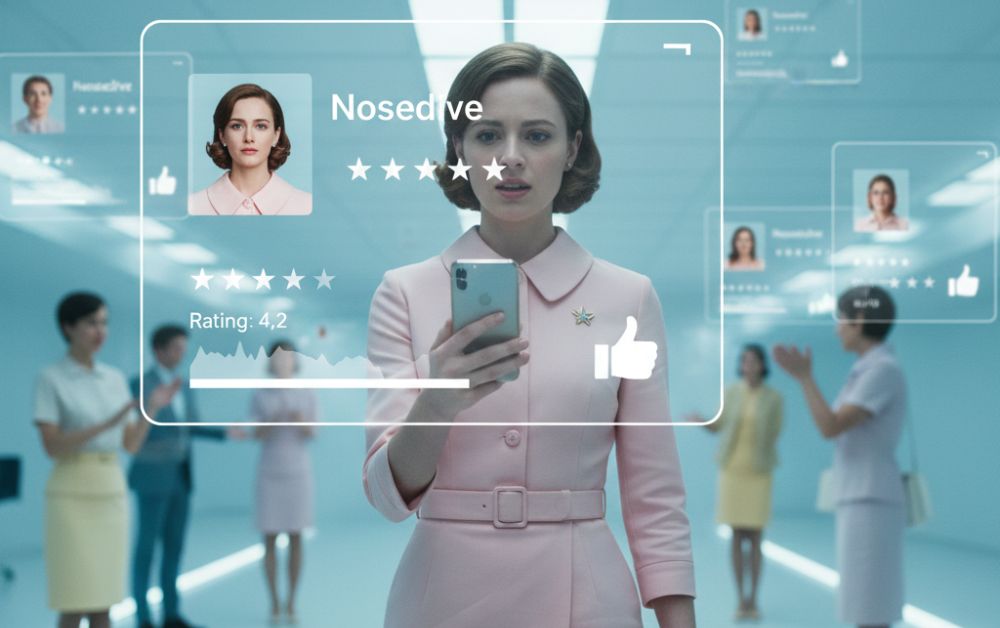
The concept of the Black Mirror Nosedive app has been silently and slowly echoed by the viewers after the episode was aired, not because it forecasts a certain technology but due to it mirroring a common emotional truth. In the Black Mirror universe, the Nosedive app is a device that rates individuals after every interaction, making social approval a visible score that determines one’s access to housing, employment, and even relationships. Although the idea is not very realistic, it is still not very far-fetched given the timing of the placement. It feels like we are living in a world where likes, follows, reviews, and ratings are, to a great extent, the determinants of how we view ourselves and others. However, the Nosedive app’s power to reveal this dainty human need for validation lies not in the scientifically implausible backdrop of a futuristic world but rather in the way it ever so gently delivers the message.
The Black Mirror Nosedive app, at its core, is a study of how technology can, in a subtle way, change human behavior. People in the Nosedive world, for instance, get to a higher level of rating and try to do it by smiling more, using less expressive but precise language, and hiding their true feelings. Social pressure is the main reason for these actions, not violence or law enforcement. This is a situation that exists in digital spaces as well, where individuals often carefully construct their online identities out of fear of being judged or rejected. The episode does not portray technology as being evil but instead poses the question to the viewers: What happens when social approval turns into a measurable currency rather than remaining a natural aspect of human connection?
Understanding the Meaning and Cultural Impact of the Black Mirror Nosedive App
The main reason for the Black Mirror Nosedive app being so influential is the emotional realism that it presents. The app does not present a new human desire; it just blows up one that is already there. Humans have ever so much concern for their reputation, their social status, and their belonging. What changes with the Nosedive app is only the scale and the visibility. When every interaction turns into a transaction and every smile into a performance; the very quality of reality is likely to disappear. The episode subtly demonstrates that continuous self-monitoring can lead to the ruination of one’s joy and the consequent development of anxiety and exhaustion as one’s new states of being.
The character’s trip portrays the silent hazard of attaching one’s self-worth to the external rating. As her rating goes down, her world gets smaller around her, not because she has ceased being nice or doing good, but simply because she is not valued by the application anymore. The above scenario is not only a social bugaboo of the individual portrayed in the episode but is also a wide-ranging concern that the present-day society where algorithms and metrics can influence the allotment of opportunities without even trying to grasp the personality or the growth of an individual. The Black Mirror Nosedive app serves as an emblem for how the complexity of human nature can be reduced to mere numbers.
On the cultural front, the episode not only raised a lot of questions but also gave a sense of déjà vu. Many spectators were able to point out the similarity between the Nosedive app and social media, customer reviews, and even evaluated employee performance, to mention but a few. Though the abovementioned systems might be advantageous, Black Mirror still creates a space for contemplation regarding the ultimate fate of human judgment in case these systems take over. The Nosedive app is a scenario of a civilization where being nice is no longer done out of a genuine heart but rather as a tactic, and where to stand apart means to be hurt rather than to grow.
Another subtle yet important motif in the Black Mirror Nosedive application is the aspect of emotional suppression. The main characters are always to be nice, even when they are in pain or feel frustrated. Negative feelings are neither worked through nor comprehended; they are simply punished. This gradually results in emotional barrenness, since individuals hardly ever feel they can present their real selves. This feature of the story strongly relates to today’s world where online kindness is frequently praised while the opposite, i.e. weakness or complicated personality, is condemned.
The story also brings the topic of injustice up in a delicate yet explosive manner. The people with top ratings are the ones who get all the perks, while the poor rated ones can hardly recover from their situation. The cycle goes on, and the social mobility becomes a dream. This situation is reminiscent of the real-world problem of digital reputation systems and algorithmic bias where being at a disadvantage from the beginning means that the bad effects of your position will last forever. The Black Mirror Nosedive application indirectly asks the question whether it is possible at all for everyone to be treated equally in a number-controlled world.
The episode is full of the darkest themes but nevertheless grants one moment of emotional liberation. Once the protagonist stops being a performer and starts telling the truth, even if it is a negative truth, the audience gets the feeling of release. With no ratings over her, she is able to touch again something very human: sincerity. The experience is that while legislation can shape conduct, honesty still stands with the same value. The Black Mirror Nosedive application does not finish with a tech fix but rather with a human one—the bravado of being authentic.
In the current digital world, the Nosedive application seems to be less of a forewarning about the future and more of a reflection of an ongoing situation. The number of likes, the quality of reviews, and the amount of engagement being tracked affect not only the perception of content but also the way users feel about themselves. However, the episode prompts the audience to take a step back and pose softly the same questions. Are we really talking about the use of technology as a tool for the purpose of humanizing it?
Conclusion
The Nosedive episode from Black Mirror still remains as a testament to the modern life scenario, for it is a communication of a soft but honest nature. It doesn’t insist on having fear of tech, rather it wants us to be cognizant of how easily human morals can be changed by computers. The episode comes to show through the act of turning social acceptance into a score that the emotional price for the constant need for validation and the so-called perfect identity is very high. In the end, Nosedive is a reminder that realness, emotional honesty, and being human in all its imperfection cannot be quantified. The episode, in a world that is more and more ruled by ratings, gives a soft invitation to stop, think, and pick togetherness over showing off one’s abilities.
FAQs
Is the Black Mirror Nosedive app real?
No, the Black Mirror Nosedive app is fictional and exists only within the episode. However, it reflects real-world social media behaviors and rating systems.
What is the main message of the Nosedive episode?
The episode explores how tying self-worth and opportunity to social ratings can harm authenticity, emotional health, and human connection.
Is the Nosedive app similar to social media platforms?
Yes, while exaggerated, the Nosedive app mirrors elements of social media such as likes, followers, and public approval metrics.
Why does the episode feel so realistic?
It feels realistic because it amplifies existing human behaviors—seeking approval, avoiding rejection, and curating identity—rather than inventing new ones.
What lesson can viewers take from the Black Mirror Nosedive app?
The episode encourages viewers to value honesty and emotional freedom over constant validation, reminding us that human worth cannot be reduced to a score.

COMMENTS