
Imagine capturing the exact shape of a complex object in seconds, down to fractions of a millimeter. That is the power of lasers for 3D scans. This te
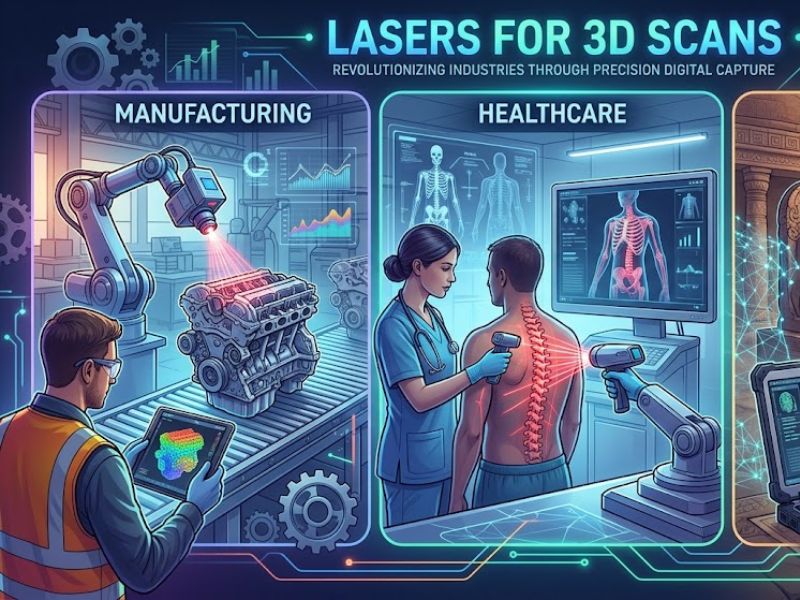
Imagine capturing the exact shape of a complex object in seconds, down to fractions of a millimeter. That is the power of lasers for 3D scans. This technology has moved from research laboratories to real-world applications across multiple industries. Whether it is inspecting a jet engine component, designing a custom prosthetic, or preserving a thousand-year-old statue, lasers for 3D scans are transforming how we measure, create, and protect physical objects. This article explores the top applications of lasers for 3D scans across three major fields: manufacturing, healthcare, and cultural heritage. By the end, you will understand why lasers for 3D scans have become indispensable tools in these industries and how they are solving real-world problems every day.
How Lasers for 3D Scans Actually Work
Before diving into applications, let us quickly understand the technology. Lasers for 3D scans work by projecting laser light onto an object and capturing the reflected light with a camera or sensor. The system calculates distance based on either the time it takes for light to return (Time-of-Flight) or the angle of the reflected light (Triangulation). Modern lasers for 3D scans can capture millions of data points per second, creating a dense “point cloud” that represents the object’s shape.
Advanced systems now use blue lasers for better performance on dark or shiny surfaces, and some have solved the 60-year-old problem of laser speckle that previously caused measurement errors. Understanding this basic principle helps explain why lasers for 3D scans are so valuable across different industries.
Application 1: Manufacturing and Quality Control
The manufacturing industry was one of the first to adopt lasers for 3D scans, and it remains the largest user today. In manufacturing, precision is everything. A part that is 0.1 millimeters out of specification can cause machinery to fail, products to leak, or assemblies to not fit together.
Quality Control and Inspection
Manufacturers use lasers for 3D scans to inspect parts during and after production. A scanner compares the actual 3D shape of a manufactured part against its original CAD (computer-aided design) model. The software highlights any deviations in a color map — green for acceptable tolerance, red for problem areas. This process, called “first article inspection,” used to take days with manual tools. With lasers for 3D scans, it takes minutes.
Reverse Engineering
When a manufacturer needs to reproduce a part that has no existing CAD file or drawings, lasers for 3D scans provide the solution. The scanner captures the part’s geometry, and specialized software converts the point cloud into a usable CAD model. This is invaluable for legacy equipment, discontinued parts, or competitor product analysis.
Injection Molding and Automotive Parts
Plastic injection molding and automotive manufacturing rely heavily on lasers for 3D scans. Mold cavities must be perfect to produce defect-free parts. Scanners check for wear, damage, or incorrect dimensions. For automotive body panels, lasers for 3D scans verify fit and finish before expensive tooling is modified.
Application 2: Healthcare and Medical Devices

The healthcare industry has embraced lasers for 3D scans for applications ranging from custom prosthetics to surgical planning. Unlike manufacturing, healthcare applications prioritize patient-specific customization over high-volume inspection.
Custom Prosthetics and Orthotics
Traditional prosthetic fitting involves messy plaster casts and manual adjustments. Lasers for 3D scans replace this process entirely. A technician scans the patient’s residual limb in minutes, creating a precise digital model. The prosthetic socket is then designed from that model and 3D printed or machined. The result is a better fit, faster turnaround, and more comfortable patient experience. The same process applies to custom orthotics (shoe inserts), braces, and supports.
Surgical Planning and Patient-Specific Guides
For complex surgeries, surgeons use lasers for 3D scans to create 3D models of a patient’s anatomy before entering the operating room. A scan of a fractured bone, for example, allows surgeons to plan exactly how to position plates and screws. Some advanced workflows even produce 3D-printed surgical guides that fit directly onto the patient’s bone, ensuring perfect placement of implants.
Dental Applications
Dentistry has been transformed by lasers for 3D scans. Intraoral scanners use laser or structured light technology to capture precise 3D models of a patient’s teeth and gums. These digital impressions replace uncomfortable putty molds. The models are then used to design crowns, bridges, aligners (like Invisalign), and dentures. The entire workflow from scan to final restoration can take days instead of weeks.
Application 3: Cultural Heritage and Preservation
Perhaps the most inspiring use of lasers for 3D scans is in preserving humanity’s cultural heritage. Museums, archaeologists, and conservationists use this technology to document, study, and protect irreplaceable artifacts and monuments.
Digitizing Artifacts and Statues
Museums around the world are using lasers for 3D scans to create high-fidelity digital copies of their collections. These digital models serve multiple purposes. Researchers anywhere in the world can study the artifact without handling the original. Museums can create physical replicas for display while storing the original safely. And if the original is damaged or destroyed, the digital model serves as a preservation record.
Monitoring Deterioration
Lasers for 3D scans allow conservators to track changes in artifacts and monuments over time. By scanning a stone statue or building facade annually, they can measure exactly how much material has eroded or cracked. This data guides conservation decisions and helps prioritize which objects need intervention first.
Reconstruction and Virtual Tourism
When Notre-Dame Cathedral burned in 2019, the world relied on lasers for 3D scans to aid reconstruction. The cathedral had been meticulously scanned years earlier, creating a precise digital record that guides the ongoing restoration. Similarly, historical sites damaged by earthquakes, war, or natural disasters can be virtually reconstructed from pre-damage scans. Virtual tourism experiences — like exploring the caves of Lascaux or the temples of Angkor Wat online — are made possible by lasers for 3D scans.
Comparison Across Applications
| Industry | Primary Goal | Typical Accuracy | Key Benefit |
| Manufacturing | Quality control, reverse engineering | 0.01 – 0.05 mm | Speed, repeatability |
| Healthcare | Customization, surgical planning | 0.1 – 0.5 mm | Patient-specific fit |
| Heritage | Documentation, preservation | 0.1 – 1.0 mm | Non-contact, permanent record |
Conclusion
Lasers for 3D scans have proven their value across manufacturing, healthcare, and cultural heritage. In manufacturing, they ensure quality and enable reverse engineering. In healthcare, they create custom prosthetics and surgical guides that fit each patient perfectly. In heritage, they preserve our cultural legacy for future generations. These three applications share a common thread: lasers for 3D scans capture precise 3D geometry quickly, non-destructively, and repeatably. As the technology continues to improve — with speckle-free illumination, faster processing, and lower costs — even more applications will emerge. Whether you are an engineer, a doctor, a curator, or simply a curious reader, lasers for 3D scans are worth understanding. They are quietly reshaping how we measure, heal, and remember.
FAQs
Q1: Are lasers for 3D scans safe for people and artifacts?
Yes. Most 3D scanning lasers are Class 1 or Class 2, meaning they are eye-safe under normal use. For artifacts, the non-contact nature means no physical touch, so no risk of damage.
Q2: Which industry uses lasers for 3D scans the most?
Manufacturing, particularly automotive and aerospace, remains the largest user. Quality control applications alone account for billions of scans annually worldwide.
Q3: Can lasers for 3D scans scan through glass or transparent objects?
No, standard laser scanners cannot see through transparent materials. The laser beam passes through or reflects unpredictably. Scanning sprays or powder coatings can temporarily make transparent surfaces scannable.
Q4: How accurate are lasers for 3D scans for heritage preservation?
Accuracy depends on the scanner, but heritage scanners typically achieve 0.1 to 1.0 millimeter accuracy. This is sufficient for documenting shape and surface detail, though not microscopic texture.
Q5: What is the difference between lasers for 3D scans and CT scans in healthcare?
Laser 3D scans capture only external surfaces. CT (computed tomography) scans see inside the body and capture internal structures. They are complementary technologies, not replacements.
Q6: Can lasers for 3D scans be used on dark or shiny objects?
Yes, modern blue laser technology handles dark and shiny surfaces much better than older red lasers. However, extremely reflective or jet-black objects may still require a scanning spray or powder.
Q7: How much do lasers for 3D scans cost for a small business?
Prices range from under
1,000forentry−levelhandheldscannersto
1,000forentry−levelhandheldscannersto50,000+ for industrial-grade equipment. Many small businesses start with scanners in the
3,000to
3,000to10,000 range

COMMENTS