
Artificial intelligence is rapidly reshaping the way software is designed, developed, tested, and deployed. As businesses strive to release applicatio
Artificial intelligence is rapidly reshaping the way software is designed, developed, tested, and deployed. As businesses strive to release applications faster while maintaining high quality, AI Software Delivery has become a key driver of innovation in modern software engineering. By integrating AI into development workflows, organizations can automate repetitive tasks, improve code quality, detect bugs earlier, and accelerate deployment. From software delivery automation to an intelligent AI development lifecycle, AI-powered tools are helping development teams work more efficiently while preparing for the future of AI software delivery.
What Is AI Software Delivery?
AI Software Delivery refers to the use of artificial intelligence throughout the software development and deployment process. Instead of relying entirely on manual coding, testing, and release management, AI-powered platforms assist developers by generating code suggestions, identifying security vulnerabilities, automating quality assurance, and optimizing deployment strategies.
AI is transforming traditional software engineering by reducing repetitive work and allowing developers to focus on solving complex business problems. Modern AI tools can analyze large codebases, detect potential issues before deployment, and recommend improvements that enhance software quality.
How AI Is Transforming Software Engineering
Artificial intelligence is influencing nearly every stage of software engineering. Development teams now use AI-powered coding assistants, automated testing platforms, predictive analytics, and intelligent deployment systems to improve productivity.
Rather than replacing software developers, AI acts as an intelligent assistant that accelerates development while supporting better decision-making. Developers can complete projects more quickly, reduce errors, and deliver more reliable applications.
As organizations adopt cloud-native development and agile methodologies, AI continues to play a growing role in streamlining software delivery processes.
Software Delivery Automation
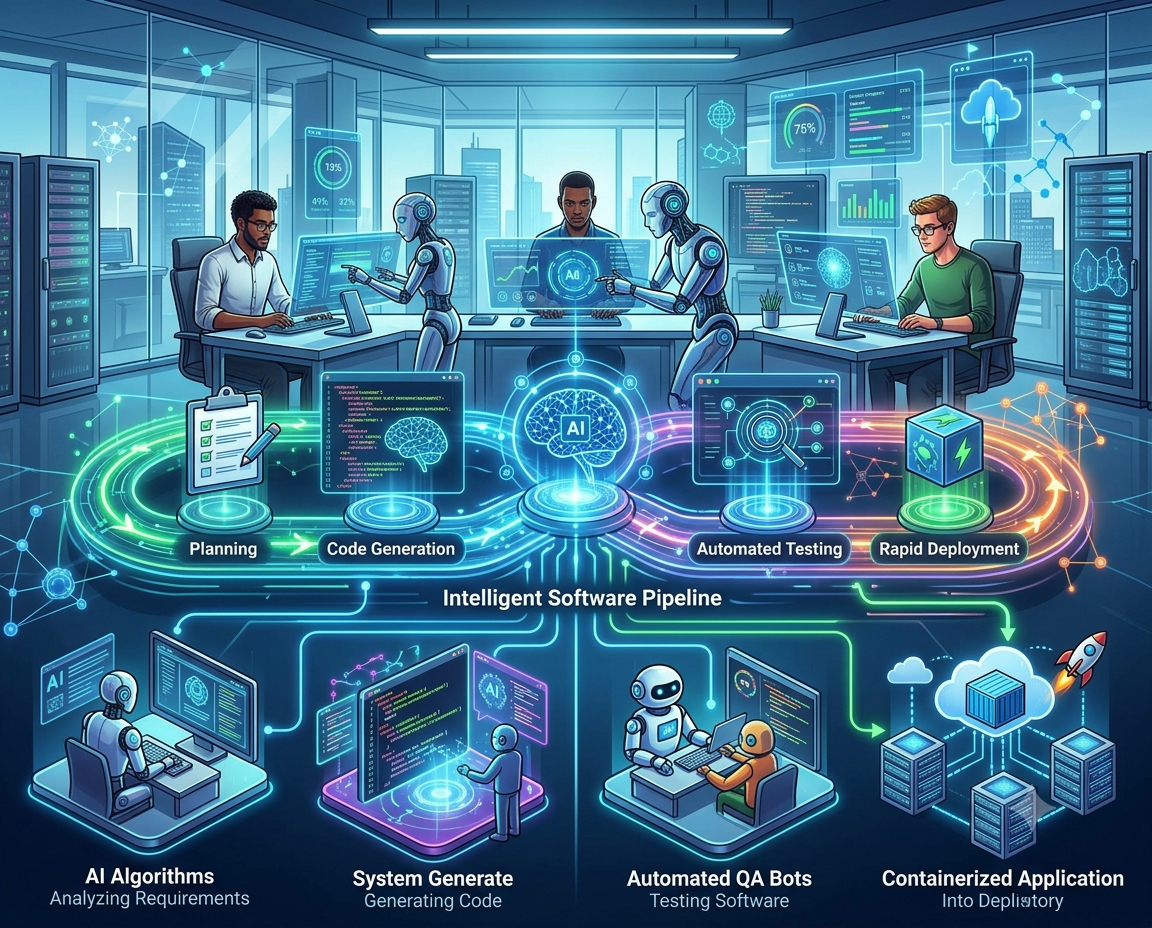
One of the biggest advantages of software delivery automation is its ability to reduce manual effort throughout the development pipeline. AI can automate repetitive tasks such as code reviews, unit testing, deployment verification, infrastructure monitoring, and release management.
Automation allows development teams to release updates more frequently while maintaining consistency across environments. Instead of spending hours on repetitive quality checks, engineers can focus on innovation and feature development.
AI-powered automation also helps reduce deployment failures by identifying potential risks before software reaches production.
AI Development Lifecycle
The AI development lifecycle extends across every phase of software creation.
Planning and Requirements
AI can analyze project requirements, estimate development timelines, identify potential risks, and recommend project priorities based on historical data.
Software Development
Modern AI coding assistants help developers write code faster by providing intelligent code completion, documentation suggestions, and bug detection while coding.
Automated Testing
AI-powered testing platforms automatically generate test cases, identify software defects, and prioritize critical issues. This helps improve software quality while reducing testing time.
Deployment
AI supports intelligent deployment strategies by monitoring application performance, identifying deployment risks, and recommending safer release schedules.
Maintenance
After deployment, AI continuously monitors applications, predicts system failures, detects unusual behavior, and assists with ongoing software optimization.
Benefits of AI Software Delivery
Organizations adopting AI Software Delivery can experience several important benefits.
Faster Development
AI reduces development time by automating repetitive coding tasks and providing intelligent code suggestions.
Improved Software Quality
Automated testing and code analysis help identify defects earlier, reducing bugs that reach production environments.
Increased Productivity
Developers spend less time performing routine work and more time building valuable features and solving complex technical problems.
Better Security
AI-powered security analysis can identify vulnerabilities, insecure coding practices, and potential threats before applications are released.
Faster Time-to-Market
Automated development and deployment pipelines help organizations deliver new software features more quickly.
AI in DevOps and CI/CD Pipelines
Modern DevOps practices depend on Continuous Integration and Continuous Deployment (CI/CD) pipelines to release software efficiently. AI strengthens these pipelines by analyzing deployment patterns, detecting failures, and recommending improvements.
AI can automatically monitor builds, identify unstable releases, optimize testing priorities, and predict deployment success based on previous releases.
As DevOps environments become increasingly complex, AI provides valuable insights that improve reliability and reduce downtime.
Intelligent Code Generation
AI Software Delivery
Generative AI has introduced a new era of intelligent software development. AI-powered coding assistants can generate code snippets, explain programming concepts, create documentation, and even suggest architecture improvements.
Although developers remain responsible for reviewing and validating generated code, these tools significantly accelerate software development and reduce repetitive programming tasks.
Challenges of AI Software Delivery
Despite its many advantages, AI Software Delivery also presents several challenges.
AI-generated code may occasionally contain errors, security vulnerabilities, or inefficient implementations that require human review. Organizations should establish proper governance to ensure AI-assisted development maintains high quality standards.
Data privacy, intellectual property, regulatory compliance, and model transparency are additional concerns that businesses must address before deploying AI at scale.
Development teams should also provide ongoing training so engineers understand how to use AI responsibly and effectively.
The Future of AI Software Delivery
The future of AI software delivery is expected to become even more intelligent as AI models continue improving. Future platforms may automatically generate application architectures, optimize infrastructure, detect security risks before code is written, and recommend performance improvements in real time.
AI may also enable self-healing software systems capable of identifying problems and applying fixes automatically with minimal human intervention.
As cloud computing, machine learning, and automation continue evolving, AI-powered software engineering will likely become a standard part of software development across industries.
Best Practices for Adopting AI Software Delivery
Organizations planning to implement AI-powered software development should follow several best practices.
- Combine AI automation with experienced human developers.
- Validate AI-generated code through peer reviews and testing.
- Maintain secure CI/CD pipelines.
- Continuously monitor application performance.
- Train development teams on responsible AI usage.
- Regularly update AI tools and security policies.
Following these practices helps organizations maximize the benefits of AI while reducing potential risks.
Why Businesses Are Investing in AI Software Delivery
Businesses are increasingly investing in AI Software Delivery because it enables faster innovation, lower development costs, and improved software reliability. Companies that embrace AI-powered development workflows can respond more quickly to market demands while delivering higher-quality applications.
From startups to enterprise organizations, AI is helping software teams build, test, deploy, and maintain applications with greater speed and confidence.
Conclusion
AI Software Delivery is transforming the future of software engineering by combining artificial intelligence, automation, and intelligent development practices. Through software delivery automation, organizations can reduce manual work, accelerate releases, and improve software quality. The AI development lifecycle enables smarter planning, coding, testing, deployment, and maintenance, making software development more efficient than ever before.
As technology continues advancing, the future of AI software delivery will likely include even greater automation, predictive intelligence, and self-optimizing development environments. While human expertise will remain essential, AI is becoming an indispensable partner in building the next generation of reliable, secure, and innovative software.
Frequently Asked Questions (FAQs)
What is AI Software Delivery?
AI Software Delivery is the use of artificial intelligence to improve software planning, coding, testing, deployment, monitoring, and maintenance throughout the software development process.
What is software delivery automation?
Software delivery automation uses AI and automation tools to streamline software testing, deployment, monitoring, and release management while reducing manual work.
What is the AI development lifecycle?
The AI development lifecycle integrates artificial intelligence into every stage of software development, including planning, coding, testing, deployment, and ongoing maintenance.
What is the future of AI software delivery?
The future of AI software delivery includes intelligent automation, predictive development, AI-assisted coding, self-healing systems, and increasingly autonomous software engineering workflows.
Why is AI important in software engineering?
AI improves productivity, enhances software quality, reduces development time, automates repetitive tasks, strengthens security, and helps organizations deliver software faster with greater reliability.

COMMENTS