
Healthcare professionals spend a considerabl amount of time creating patient notes, updating medical records, and documenting consultations. As techno
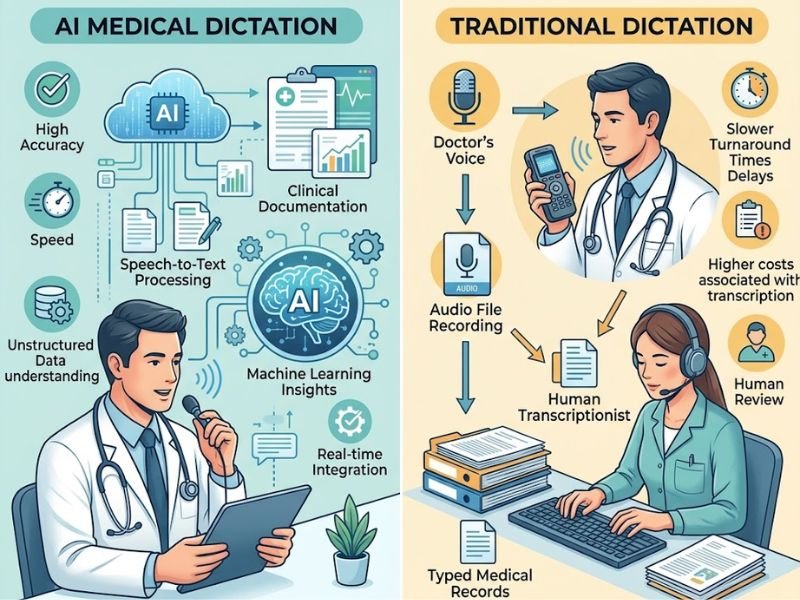
Healthcare professionals spend a considerabl amount of time creating patient notes, updating medical records, and documenting consultations. As technology advances, AI Medical Dictation vs Traditional Dictation has become an important topic for doctors, nurses, clinics, and healthcare organizations. Both approaches allow professionals to turn spoken information into written documentation, but the technology and workflow behind them are different. AI medical dictation uses artificial intelligence and advanced speech technologies to process spoken information, while traditional dictation typically depends on manual transcription or conventional speech-to-text software. Understanding these differences can help healthcare providers choose a documentation method that fits their workflow, accuracy requirements, and operational needs.
What Is AI Medical Dictation?
AI medical dictation is a technology that uses artificial intelligence to convert spoken medical information into written documentation. A doctor can dictate notes, describe a patient’s symptoms, record observations, or summarize a consultation without manually typing every detail. Advanced systems can recognize medical terminology and understand the context of spoken information, helping create organized clinical notes.
One of the main advantages of AI medical dictation is that it can reduce repetitive administrative work. Instead of spending additional time typing after an appointment, healthcare professionals can speak their notes and review the generated documentation. Some systems can also help organize information into different sections of a clinical note, making the final document easier to read and manage.
What Is Traditional Medical Dictation?
Traditional medical dictation has been used in healthcare for many years. In a traditional workflow, a healthcare professional records information using a voice recorder or basic dictation software. The recording is then converted into written text, often by a medical transcriptionist or a conventional speech-to-text system.
Human transcriptionists can provide valuable expertise because they are familiar with medical terminology and documentation requirements. However, the process can involve several steps, including recording, transferring the audio, transcription, proofreading, editing, and final approval. These steps may increase the time required to complete documentation.
Traditional dictation can still be effective, especially for healthcare organizations that already have experienced transcription teams and established documentation processes. However, modern AI technology offers an alternative that can automate many parts of this workflow.
AI Medical Dictation vs Traditional Dictation: Key Differences
The biggest difference in AI Medical Dictation vs Traditional Dictation is the way spoken information is processed. Traditional dictation often relies on a transcriptionist or basic speech-to-text technology, while AI medical dictation uses artificial intelligence to analyze speech, terminology, and context.
Speed is another major difference. Traditional transcription can take hours or longer depending on workload and the availability of transcription staff. AI-based systems can process spoken information much faster, allowing healthcare professionals to review their documentation sooner.
AI systems can also provide more advanced contextual processing. Rather than simply converting individual words into text, some solutions are designed to understand medical language and organize information into useful documentation. However, AI-generated notes should still be reviewed carefully because speech recognition and language models can make mistakes.
The Role of AI-Powered Clinical Documentation
AI-powered clinical documentation is becoming an important part of modern healthcare technology. It can help reduce the amount of manual work involved in creating clinical notes and other patient documentation. By processing spoken conversations or dictated information, AI systems can help healthcare professionals create structured documentation more efficiently.
The value of AI-powered clinical documentation is not simply about converting speech into text. Advanced systems may identify important information from a conversation and organize it according to a clinical documentation format. This can help reduce repetitive data entry and allow providers to focus more attention on patient interactions.
However, healthcare organizations should introduce these systems carefully. Staff need to understand how the technology works, how generated notes should be reviewed, and how patient information is protected. Human oversight remains an essential part of responsible clinical documentation.
How Medical Speech Recognition Improves Healthcare Workflows
Medical speech recognition allows healthcare professionals to use their voice to create documentation instead of relying entirely on keyboards. This technology is designed to recognize medical terminology, names, phrases, and other language commonly used in healthcare environments.
For busy professionals, medical speech recognition can make documentation more convenient. Doctors can dictate notes immediately after an appointment or during appropriate parts of their workflow. This may reduce the amount of time spent typing and help prevent documentation from building up at the end of the working day.
Modern speech-recognition systems can also become more effective when they are designed for specific healthcare environments. Nevertheless, accuracy can be affected by background noise, pronunciation, accents, microphone quality, and uncommon terminology. For this reason, generated documentation should always be checked before it is finalized.
AI Dictation and Electronic Health Records
Electronic health records have become central to modern healthcare documentation. They allow authorized healthcare professionals to store, access, and manage patient information digitally. Integrating AI dictation with electronic health records can potentially make documentation workflows more efficient.
Instead of creating a note separately and manually transferring information into an electronic health record, an integrated solution may allow generated documentation to move into the appropriate workflow for review. This can reduce duplicate data entry and help professionals complete documentation more efficiently.
However, integration capabilities vary between different software platforms. Healthcare organizations should evaluate compatibility, security controls, user permissions, and workflow requirements before implementing an AI dictation solution. A technology that does not integrate well with an existing electronic health record system may create additional work instead of reducing it.
Accuracy, Speed, and Productivity

AI Medical Dictation vs Traditional Dictation
Accuracy is one of the most important factors when comparing medical dictation technologies. Medical documentation can contain diagnoses, medication names, symptoms, treatment instructions, and other sensitive information. Errors can therefore create serious documentation problems.
AI medical dictation can provide fast transcription and may recognize a wide range of medical vocabulary. Traditional transcription performed by trained professionals can also provide strong accuracy because human transcriptionists can use context and professional knowledge when reviewing recordings.
Speed is where AI solutions can provide a significant advantage. Automated processing can reduce waiting times and allow providers to review documentation sooner. This can contribute to better productivity, particularly in busy clinical environments.
Cost and Efficiency
Cost should also be considered when evaluating AI Medical Dictation vs Traditional Dictation. Traditional dictation may involve expenses related to transcription staff, outsourcing, equipment, and administrative management. These costs can increase as documentation volume grows.
AI medical dictation typically involves software or subscription costs. Although organizations may need to invest in implementation, training, and integration, automation can reduce the amount of manual transcription required. The actual financial benefit depends on factors such as the size of the organization, documentation volume, software pricing, and existing transcription processes.
Healthcare organizations should compare the total cost of ownership rather than looking only at the initial software price.
Privacy and Data Security
Medical documentation contains highly sensitive patient information, making privacy and data security essential considerations. Healthcare organizations should understand how an AI dictation system collects, processes, stores, and protects voice recordings and generated text.
Organizations should evaluate security features, access controls, data retention policies, encryption practices, and applicable healthcare privacy requirements before selecting a platform. Employees should also receive training on safe usage and appropriate handling of patient information.
Traditional dictation also requires security measures. Audio recordings, transcripts, printed documents, and digital files can all contain confidential information. Regardless of the technology used, healthcare providers must establish appropriate procedures for protecting patient data.
Which Dictation Method Is Better for Healthcare?
The answer to AI Medical Dictation vs Traditional Dictation depends on the specific needs of each healthcare organization. AI medical dictation may be a strong choice for providers who want faster documentation, automation, and reduced administrative workload. Traditional dictation may remain valuable for organizations with established transcription departments and workflows.
For many healthcare environments, a combination of technology and human oversight may provide the best balance. AI can help create an initial draft quickly, while healthcare professionals review the documentation for accuracy and completeness before it becomes part of the official patient record.
The best solution should be selected based on accuracy, efficiency, security, integration, ease of use, and the organization’s ability to support the technology.
Conclusion
The comparison of AI Medical Dictation vs Traditional Dictation highlights the changing nature of healthcare documentation. Traditional dictation remains a practical approach, particularly when supported by experienced transcription professionals. AI medical dictation, meanwhile, can offer faster processing, advanced medical speech recognition, and support for AI-powered clinical documentation. Integration with electronic health records can further improve the documentation workflow when implemented correctly. However, AI is not a substitute for professional judgment. Healthcare providers should review generated documentation carefully and prioritize accuracy, privacy, security, and patient safety when adopting new dictation technologies.
FAQs
What is AI medical dictation?
AI medical dictation uses artificial intelligence and speech-recognition technology to convert spoken healthcare information into written or structured clinical documentation.
Is AI medical dictation better than traditional dictation?
AI medical dictation can be faster and more automated, while traditional dictation may offer the benefit of human transcription expertise. The better option depends on the organization’s workflow and requirements.
What is medical speech recognition?
Medical speech recognition is technology designed to convert spoken language into text while recognizing healthcare-specific terminology and vocabulary.
Can AI dictation work with electronic health records?
Some AI dictation platforms can integrate with electronic health record systems. Organizations should verify compatibility, security, and workflow requirements before implementation.
Does AI medical dictation eliminate the need for human review?
No. AI-generated documentation should be reviewed by an appropriate healthcare professional to identify errors, omissions, or incorrect interpretations before finalization.
Is AI medical dictation secure?
Security depends on the specific technology provider and implementation. Healthcare organizations should evaluate privacy controls, data handling, access management, and applicable regulatory requirements before using an AI dictation platform.

COMMENTS