
Electrical resistance is one of the most important concepts in electricity and electronics. It explains how materials oppose the flow of electric curr
Electrical resistance is one of the most important concepts in electricity and electronics. It explains how materials oppose the flow of electric current and why different electrical components behave differently when connected to a power source. From household appliances and electric heaters to smartphones and industrial machines, electrical resistance plays a vital role in the safe and efficient operation of electrical systems. Understanding resistance in electrical circuits helps students, electricians, and electronics enthusiasts learn how voltage, current, and power work together. In this article, we will explore what electrical resistance means, how it works, the different types of resistance, Ohm’s law, the factors that affect resistance, and its practical applications in everyday life.
What Is Electrical Resistance?
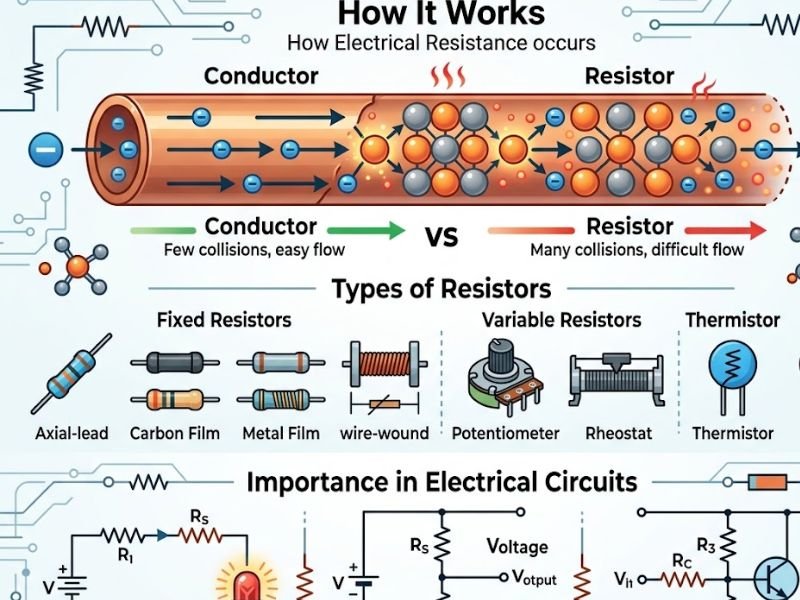
Electrical resistance is the opposition that a material or electrical component offers to the flow of electric current. When voltage is applied across a conductor, electrons begin moving through it. The material’s resistance makes this movement more difficult, limiting the amount of current that can flow. Materials such as copper and aluminum generally have low resistance, which makes them useful for electrical wiring. Other materials, such as rubber, glass, and plastic, have very high resistance and are commonly used as electrical insulators.
The unit of electrical resistance is the ohm, represented by the symbol Ω. A component has a resistance of one ohm when a voltage of one volt produces a current of one ampere through it under the relevant conditions. Resistance is not the same as voltage or current. Voltage provides the electrical potential difference, current represents the flow of charge, and resistance determines how strongly that flow is opposed.
How Does Electrical Resistance Work?
Electrical resistance works because moving electrons interact with the atoms and other particles inside a material. In a metal conductor, electrons can move through the material, but they do not travel without interference. Their interactions with the atomic structure create resistance and convert some electrical energy into heat.
This process is known as resistive heating, or the Joule effect. For example, when current passes through the heating element of an electric kettle or toaster, the element’s resistance converts electrical energy into thermal energy. The heat produced depends on the amount of current, the resistance, and the time the current flows.
Resistance also helps control current in electrical circuits. If a circuit contains a high-resistance component, less current flows for the same applied voltage than it would through a low-resistance component. This principle is essential in designing electrical devices, protecting sensitive components, and managing energy consumption.
Types of Electrical Resistance
Electrical resistance can be understood in several ways depending on the material, component, and conditions in which it operates. The following are common types of resistance found in electrical and electronic systems.
1. Fixed Resistance
Fixed resistance is the resistance provided by a component whose value is designed to remain approximately constant under normal operating conditions. Fixed resistors are widely used in electronic circuits to limit current, divide voltage, and establish operating conditions for components such as LEDs and transistors.
For example, a resistor connected in series with an LED can limit the current and prevent the LED from being damaged by excessive electrical flow.
2. Variable Resistance
Variable resistance is resistance that can be adjusted manually or electronically. A potentiometer is a common example of a variable resistor. It allows users to change the resistance by turning a knob or moving a control.
Variable resistors are used in volume controls, lighting dimmers, and adjustable electronic circuits. They provide flexibility because the resistance can be changed according to the requirements of the device.
3. Internal Resistance
Internal resistance is the opposition to current within a power source, such as a battery or generator. A battery does not behave like an ideal voltage source because some energy is lost inside it as current flows. This internal resistance can cause the terminal voltage of a battery to decrease when the battery supplies a larger current.
Understanding internal resistance is important for evaluating battery performance, charging systems, and portable electronic devices.
4. Resistance of Conductors
Conductors such as copper, aluminum, and steel have resistance that depends on their material properties, length, and cross-sectional area. Although these materials are good electrical conductors, their resistance is never exactly zero under ordinary conditions.
In long electrical cables, even a small amount of resistance can produce noticeable voltage drops and energy losses. Engineers therefore select suitable wire sizes and materials for different electrical applications.
Ohm’s Law and Electrical Resistance
Electrical Resistance
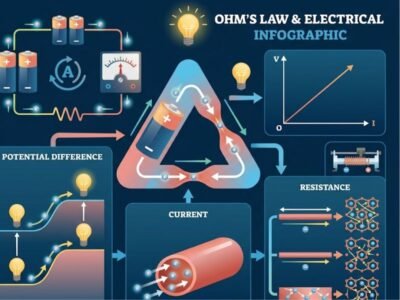
Ohm’s law is a fundamental relationship used to calculate electrical resistance in electrical circuits. It explains how voltage, current, and resistance are connected when the conditions of the circuit are suitable for Ohm’s law to apply.
The formula is:
V = I × R
Where:
- V = Voltage in volts (V)
- I = Current in amperes (A)
- R = Resistance in ohms (Ω)
The formula can also be rearranged to calculate resistance:
R = V ÷ I
For example, if a circuit has a voltage of 12 volts and a current of 2 amperes, its resistance is:
R = 12 ÷ 2 = 6 Ω
This means the circuit has a resistance of six ohms under those conditions. Ohm’s law is useful for selecting resistors, troubleshooting electrical problems, and understanding how changes in voltage affect current.
Factors That Affect Electrical Resistance
Several factors determine how much resistance a material or component offers to electric current. Understanding these factors is important for designing efficient electrical circuits.
Material
Different materials have different electrical resistivities. Copper has relatively low resistivity, which is why it is widely used in electrical wires. Materials with higher resistivity offer more opposition to current flow.
Length
The longer a conductor is, the greater its resistance, assuming the material and cross-sectional area remain the same. Electrons must travel through a greater distance, increasing the overall opposition to current.
Cross-Sectional Area
A conductor with a larger cross-sectional area generally has lower resistance. Thicker wires provide more space for current to flow, reducing resistance compared with thinner wires made from the same material and under similar conditions.
Temperature
Temperature can affect resistance significantly. In most metallic conductors, resistance increases as temperature rises. This is because increased atomic vibrations make electron movement more difficult. Some other materials, including certain semiconductors, behave differently and may show decreasing resistance as temperature increases.
Electrical Resistance in Series and Parallel Circuits
Electrical resistance behaves differently depending on how components are connected. In a series circuit, resistors are connected along one path, so the total resistance is the sum of the individual resistances.
For example, if three resistors of 2 Ω, 3 Ω, and 5 Ω are connected in series, the total resistance is 10 Ω. This higher resistance limits the current flowing through the circuit.
In a parallel circuit, components are connected across the same two points, creating multiple paths for current. The total resistance of parallel resistors is lower than the resistance of the smallest individual resistor. For two resistors, the formula is:
1 ÷ Rₜ = 1 ÷ R₁ + 1 ÷ R₂
These principles are important in household wiring, electronic devices, and electrical distribution systems.
Importance of Electrical Resistance in Everyday Life
Electrical resistance is essential for controlling current, producing heat, and protecting electrical components. Electric heaters, irons, kettles, and toasters use resistive heating to convert electrical energy into heat. In electronic devices, resistors help regulate voltage and current, protect LEDs, and establish the correct operating conditions for circuit components.
Resistance is also important in electrical safety. Properly selected resistors and electrical wiring can help prevent excessive current and overheating. Insulating materials with high resistance reduce the risk of accidental current flow through unwanted paths. In industrial systems, engineers consider resistance when designing motors, transformers, power supplies, and electrical cables.
How to Measure Electrical Resistance
A multimeter is one of the most common tools used to measure electrical resistance. To measure the resistance of a component, the circuit should normally be switched off and the component isolated from other circuit paths. The multimeter is then set to the resistance or ohms mode, and its probes are placed across the component.
The displayed value indicates the resistance measured under the instrument’s test conditions. Measuring resistance in a live circuit can produce inaccurate readings and may damage the meter, so appropriate electrical safety procedures are important.
Conclusion
Electrical resistance is a fundamental property that controls the flow of current in electrical circuits. It is measured in ohms and is influenced by material, length, cross-sectional area, and temperature. Ohm’s law provides a simple way to calculate the relationship between voltage, current, and resistance. From heating appliances and household wiring to advanced electronic systems, resistance is essential for controlling energy and ensuring reliable operation. By understanding how electrical resistance works, students and professionals can better design, analyze, and troubleshoot electrical circuits.
Frequently Asked Questions
What is electrical resistance?
Electrical resistance is the opposition a material or component offers to the flow of electric current. It is measured in ohms (Ω).
What is the formula for electrical resistance?
The formula is R = V ÷ I, where R is resistance, V is voltage, and I is current.
What is Ohm’s law?
Ohm’s law states that voltage equals current multiplied by resistance: V = I × R, under conditions where the relationship applies.
Does higher resistance mean lower current?
Yes, if the applied voltage remains constant and the circuit behaves according to Ohm’s law, increasing resistance decreases the current.
What factors affect electrical resistance?
The main factors are the material’s resistivity, conductor length, cross-sectional area, and temperature.

COMMENTS