
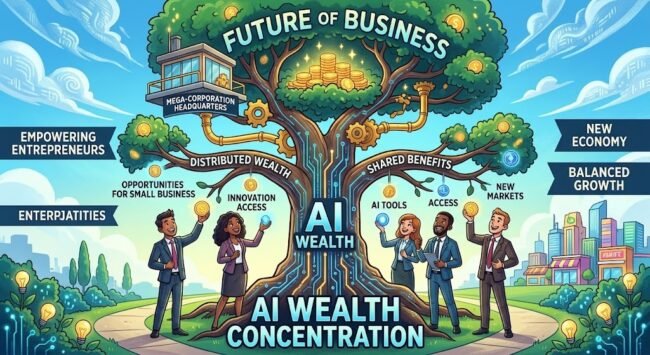
The impact of artificial intelligence on business operations, competition, and profit generation is changing significantly. From chatbots to complex data analysis, artificial intelligence opens up many opportunities for businesses within various industries. Nevertheless, not all can benefit equally from the technology. Wealth concentration in AI relates to the increasing likelihood of a substantial part of profits generated from artificial intelligence ending up in the hands of a few organizations and individuals. Given the increasing adoption of artificial intelligence in 2026, this trend should be understood well by entrepreneurs, workers, and business leaders.
What Is AI Wealth Concentration?
AI wealth concentration describes a situation in which the economic benefits of artificial intelligence are disproportionately captured by companies and individuals who control essential resources, such as computing infrastructure, advanced AI models, valuable data, and investment capital. Development of cutting-edge AI systems may call for significant investment of funds, expertise, and computers. Big tech corporations usually have more access to these resources compared to their competitors. It may be an advantage for them when developing innovative products and services and entering new markets. Access to computing power, data, and expertise has been noted by the OECD as one of the competitive concerns in AI markets.
At the same time, resource concentration does not always happen. AI technologies may also become cheaper, which will benefit smaller companies and help them increase efficiency and compete with bigger players. The final result will depend on the way the technology is developed, distributed, and utilized.
How AI Wealth Concentration Is Changing Business Competition
Artificial intelligence generates new business competition methods which companies use to obtain customers and expand their market presence. Organizations which have enough resources can spend their money on sophisticated models while creating dedicated infrastructure and recruiting skilled AI experts. These investments will help them build improved services while cutting down operational expenses and achieve fast responses to market shifts. Large companies can integrate AI technology into their existing product lineup which customers already use. Their services will become more accessible to customers through this approach which will also strengthen their current customer connections. A company which operates multiple AI supply chain components will achieve extra benefits because it can access both computing power and distribution networks and customer information.
Smaller business entities encounter various obstacles which differ from those that larger organizations face. They will need to use external AI solutions because they lack the ability to create their own AI systems. The business faces cost and operational restrictions because of its subscription fees and usage limits and its need to depend on external platforms. The growing AI provider competition together with lower-cost tools present new possibilities for s.
The Role of Big Technology Companies
It is important for large tech firms to participate in the development of AI since they usually have the resources and skills required to develop advanced AI technologies. While such investments are good for innovation, improved computing services, and making AI useful for businesses all over the world, concentration in vital areas of the AI industry might lead to competition issues. Namely, if there are few providers of critical models, cloud computing services, and special hardware, there would be fewer options for businesses. It might affect pricing, availability of products, and entry of new competitors.
The task at hand is to encourage investments while ensuring competitiveness in the markets. Innovation is important for business, and so are choices, clear pricing, and switching.
The Impact on Jobs, Wages, and Business Productivity
AI Wealth Concentration
AI is capable of performing routine tasks, assisting employees in analysis of information, and supporting quicker decision-making. This technology may allow businesses to become more productive and to decrease some of their operating costs. Workers who acquire skills of working effectively with AI can become more productive and perform more valuable functions. Nevertheless, there can be differences in the effects of AI adoption for workers and business. For example, some positions may undergo drastic changes because many tasks will be automated and done without any human input at all. However, other jobs will become more valuable since they will include professional judgment, industry expertise, and work with AI.
This situation is discussed in a research report by the International Monetary Fund in 2025. AI adoption can have different impacts on wage and wealth inequality, in part because highly-paid workers can become more productive, while owners of capital will gain additional income from the financial gains of AI. Preparation of business for AI through training of employees and changes in workflow can assist in ensuring sustainability of the process for business. Apart from reduction of labor costs, businesses can utilize AI for enhancing services, developing products and
Opportunities for Small Businesses and Startups
Although AI wealth concentration presents challenges, artificial intelligence can help smaller companies compete more effectively. Affordable AI tools can support marketing, customer service, research, content development, and administrative work without requiring a large in-house technical team. For instance, an online business can utilize AI to analyze customer feedback, whereas a small consulting business can make its research and reporting process automated. A small business can also utilize development software powered by AI to develop the first prototype of the product.
According to the OECD, small and medium-sized companies adopt AI less frequently than large organizations because of the lack of certain skills, funding, access to data, and digital infrastructure.In order to derive the benefits of using AI, small business owners should define their specific problem areas, choose suitable tools, start with smaller projects and protect the personal information of their customers.
How Businesses Can Respond to AI Wealth Concentration
There is no way for businesses to get rid of all structural issues in the AI economy. However, they can implement several practices aimed at reducing their dependency and increasing competitiveness. To begin with, companies have to consider not just one, but several providers of AI solutions. Employing flexible systems that enable easy access to important data makes changing a provider easier in case of a price increase or changes in demands.
Secondly, organizations have to develop employees’ skills. In particular, training workers on assessing information provided by AI solutions, using automation, and solving problems with new means may increase the benefits of technology usage. Lastly, government representatives can promote competitive environment through analyzing the concentration of markets, making digital infrastructure available for everybody, and fostering education and innovation.
The Future of AI Wealth Concentration
In the future, the wealth that will be generated by AI will depend on several factors. These include the costs involved, competition, education, business investments, and government policies. If the high-end technologies and resources that will be needed to develop advanced artificial intelligence applications continue to be out of reach, then companies that already have an edge could end up enjoying most of the fruits.
With lower prices and increased access to advanced AI technology, there would be more companies that will enjoy the benefits of artificial intelligence. Open-source models, competition in the cloud, and artificial intelligence education could go a long way in ensuring that more firms benefit. It is not about preventing companies from making innovations; rather, it is about coming up with a system where innovation creates economic benefits for everyone.
Conclusion
AI is altering the landscape of business competition through the creation of new forms of innovation, automation of operations, and the generation of profits. It may be worth noting that the economic advantages associated with the use of AI may not be shared equally across all firms and workers. Wealth inequality resulting from the use of AI underlines the necessity for competitiveness, availability of technology, training of employees, and ethical approaches to doing business. Large firms are bound to be key players in the development of AI but small firms can take advantage as well.
Related articles
Keep reading more from this topic.
Is Manus AI Good for Small Businesses in 2026
Small businesses often need to manage marketing, customer communication, research, reporting, and daily operations…

Hammer Wave 2 Review: Is This Bluetooth Speaker Worth Buying in 2026
Finding an affordable Bluetooth speaker that delivers enjoyable sound, attractive lighting, and convenient connectivity…

Bachelor of Technology (B.Tech): Courses, Specializations, and Career Opportunities
Introduction Technology continues to influence almost every part of modern life, creating new opportunities…
COMMENTS