
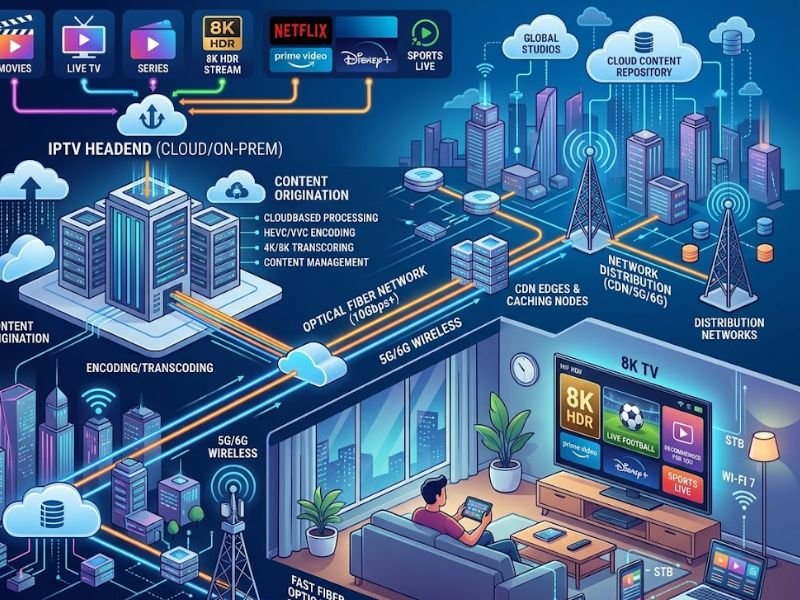
Introduction Television is no longer limited to traditional broadcast signals delivered through cable or satellite networks. In IPTV Infrastructure 2
Introduction
Television is no longer limited to traditional broadcast signals delivered through cable or satellite networks. In IPTV Infrastructure 2026, internet-powered systems are playing an increasingly important role in how video content is delivered, managed, and viewed. Modern IPTV streaming technology allows video services to use internet protocols to deliver live channels, on-demand content, and other digital media to compatible devices. Behind the viewing experience is a complex video delivery infrastructure involving networks, servers, content distribution, security, and software. As internet-based television continues to evolve, infrastructure quality will remain essential for delivering reliable and high-quality viewing experiences.
What Is IPTV Infrastructure?
IPTV infrastructure refers to the technology and systems used to deliver television and video content through IP networks. Unlike traditional broadcast methods, IPTV uses internet protocol technology to transmit content to users.
A complete system may include content sources, encoding equipment, media servers, storage, content delivery networks, network infrastructure, applications, and compatible user devices.
The viewer only sees the final video on a television, smartphone, tablet, or computer, but several technologies work together behind the scenes to make that experience possible.
A strong infrastructure is particularly important when many users are watching content simultaneously.
How IPTV Streaming Technology Works
IPTV streaming technology begins with video content that must be prepared for digital delivery. Depending on the source, content may be captured, encoded, processed, stored, and distributed across a network.
When a viewer requests a program, the system identifies the content and delivers the appropriate stream to the user’s device.
For live television, the infrastructure must support continuous delivery with minimal delay. For on-demand content, the system must be able to retrieve and stream requested files efficiently.
The quality of the final experience depends on several factors, including encoding quality, available bandwidth, network stability, and the capabilities of the user’s device.
Key Components of IPTV Infrastructure 2026
The modern IPTV ecosystem consists of several important components.
First, content acquisition brings video into the system from authorized sources. The content may then be encoded into formats suitable for streaming across different devices and network conditions.
Media servers and storage systems manage the content, while content delivery technologies help distribute it efficiently.
User management systems may handle subscriptions, authentication, and account access. Applications and set-top boxes provide the interface through which viewers browse and watch available content.
In IPTV Infrastructure 2026, these components increasingly work together through cloud-based and software-driven systems.
The Role of Video Delivery Infrastructure
A reliable video delivery infrastructure is essential for maintaining a smooth viewing experience.
Video files can be large and require significant network resources, especially when delivered at high resolutions. If the infrastructure is poorly designed, users may experience buffering, delays, reduced quality, or connection failures.
Content delivery networks can help distribute content closer to viewers, reducing the distance data must travel.
Adaptive bitrate streaming is another important technology. It can adjust video quality based on available network conditions, helping users continue watching even when their internet connection changes.
These technologies are particularly valuable when services need to support large audiences across different locations.
Cloud Computing and IPTV
Cloud technology is changing how video platforms are built and managed.
Instead of relying entirely on physical servers located in one facility, providers can use cloud resources to scale processing and storage according to demand.
This flexibility can be useful during major live events or periods of increased viewing.
Cloud-based systems can also simplify content management and support distributed infrastructure.
However, cloud architecture must still be carefully designed. Storage costs, network performance, security, and service availability are all important considerations.
The goal is not simply to move everything to the cloud but to build an architecture that matches the needs of the service.
How 5G and Faster Networks Support Internet-Based Television

IPTV Infrastructure 2026
Faster mobile and fixed networks are improving the possibilities for internet-based television.
Higher bandwidth can support higher-quality video, while improved network performance can help reduce delays and buffering.
5G may also make high-quality mobile video more practical in areas with suitable coverage.
This can give viewers greater flexibility to watch content outside the home.
However, network performance can vary depending on location, congestion, device capability, and service plans. Faster network technology does not automatically guarantee the same experience for every user.
A reliable video service must account for changing real-world network conditions.
Security and Content Protection
Security is a major part of IPTV Infrastructure 2026.
Video services may need to protect user accounts, payment information, content rights, and platform infrastructure.
Authentication systems help ensure that only authorized users can access accounts and services.
Digital rights management and other content protection technologies may also be used by licensed services to manage how protected content is accessed.
Cybersecurity practices are equally important. Providers should protect servers, applications, APIs, and administrative accounts from unauthorized access.
Regular updates, strong authentication, monitoring, and secure software development practices can all contribute to a more resilient system.
Improving the Viewer Experience
Infrastructure is not only about servers and networks. The final goal is to create a better experience for viewers.
A modern service should provide fast navigation, reliable playback, useful search tools, and compatibility with different devices.
Personalization may also help users discover relevant content based on their viewing preferences, where appropriate and with suitable privacy controls.
Artificial intelligence can assist with content recommendations, automated metadata, and operational monitoring.
However, the best technology should remain largely invisible to the viewer. If the infrastructure works well, users can focus on the content instead of worrying about buffering or technical problems.
Scalability and Growing Demand
One of the biggest challenges for video platforms is handling changes in demand.
A service may have a normal number of viewers most of the time but experience a major increase during a live sports event, product launch, or popular entertainment release.
Scalable video delivery infrastructure can help manage these changes by increasing available resources when demand grows.
Load balancing and distributed delivery can also reduce pressure on individual servers.
Planning for peak demand is important because a service that works well with a small audience may experience problems when thousands or millions of viewers attempt to watch simultaneously.
AI and Automation in IPTV Infrastructure
Artificial intelligence and automation are becoming more useful for managing complex digital platforms.
AI-assisted systems may help identify unusual network behavior, analyze performance, organize metadata, or improve content recommendations.
Automation can also reduce repetitive operational tasks.
For example, monitoring systems can track infrastructure health and notify technical teams when performance falls outside expected levels.
These technologies should support human decision-making rather than completely replace it.
Video platforms still require skilled teams to manage architecture, security, content rights, and service quality.
Challenges Facing IPTV Infrastructure
Despite its advantages, modern IPTV technology faces several challenges.
Bandwidth limitations can affect users in areas with slower internet connections. Network congestion may also reduce performance during busy periods.
Content licensing and regional rights can create additional complexity for legal streaming services.
Security threats remain another concern because video platforms rely on connected systems, user accounts, and online infrastructure.
Compatibility can also be challenging. A service may need to work across smart TVs, streaming devices, mobile applications, browsers, and different operating systems.
Building a system that performs consistently across all these environments requires careful testing and ongoing development.
The Future of IPTV Infrastructure 2026
The future of IPTV Infrastructure 2026 will likely involve more flexible, distributed, and software-driven systems.
Cloud computing, edge infrastructure, improved networks, automation, and advanced streaming technologies are all expected to influence how digital television evolves.
Viewers may also expect greater flexibility, allowing them to move between devices without losing their place or compromising video quality.
As demand for high-resolution and interactive content increases, infrastructure providers will need to improve efficiency as well as capacity.
The future of television will depend not only on the content available but also on the technology that delivers it reliably.
Why IPTV Infrastructure 2026 Matters
IPTV Infrastructure 2026 matters because the quality of digital television depends heavily on the systems operating behind the screen.
Viewers expect content to start quickly, play smoothly, and work across multiple devices.
To meet those expectations, providers need reliable IPTV streaming technology, scalable networks, secure platforms, and efficient content distribution.
As viewing habits continue to move toward connected devices, the infrastructure supporting digital video will become even more important.
Conclusion
IPTV Infrastructure 2026 represents an important stage in the evolution of digital television. Modern IPTV streaming technology is changing how video content is delivered by combining cloud systems, content distribution, adaptive streaming, automation, and faster networks. A strong video delivery infrastructure can help provide reliable playback and support growing audiences, while internet-based television gives viewers greater flexibility in how and where they watch content. As technology continues to develop, successful platforms will need to balance performance, scalability, security, legal compliance, and user experience.

COMMENTS