
Introduction
Artificial intelligence is transforming industries, businesses, education, healthcare, and communication. However, as AI technologies become more powerful, concerns about privacy, misinformation, cybersecurity, and responsible development are also increasing. Governments, technology companies, researchers, and international organizations are working together to understand these risks and establish effective safety measures.
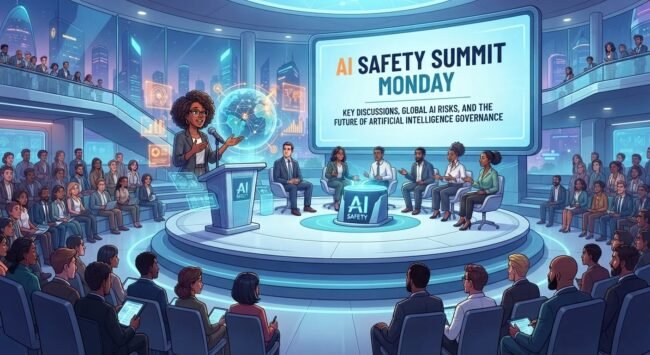
The AI Safety Summit Monday, held on November 23, 2026, in Bridgetown, Barbados, brought international attention to the need for stronger cooperation on artificial intelligence governance. The meeting focused on global AI risks, the ability of countries to evaluate advanced AI systems, and ensuring that developing nations can participate in decisions about AI safety.
techtimes.com+1
What Was Discussed at the AI Safety Summit Monday?
The summit was co-hosted by Barbados Prime Minister Mia Amor Mottley and United Nations Secretary-General António Guterres. More than 250 participants from governments, technology companies, scientific institutions, and civil society took part in discussions about making AI safer and more accessible.
Summit on AI Safety+1
The discussions focused on two major areas:
- Multilateral AI Risk Management: Participants explored how countries can work together to evaluate AI risks, share information, and develop compatible safety approaches.
- AI for Humanity: Discussions examined how AI benefits can reach more communities, particularly developing countries that have limited technological resources.
These discussions highlighted the importance of international cooperation rather than allowing a small number of powerful countries and technology companies to determine the future of AI.
Major Global AI Risks Highlighted During the Summit
Artificial intelligence offers significant opportunities, but its rapid development also introduces challenges that require attention from governments and technology developers.
1. Cybersecurity Threats
AI can help organizations improve cybersecurity, but advanced systems can also be misused to develop sophisticated cyberattacks, automate malicious activities, and exploit digital vulnerabilities.
2. Misinformation and Digital Manipulation
AI-generated images, videos, and audio can make misleading information more convincing. Deepfakes and automated content can influence public opinion, damage reputations, and create confusion during important events.
3. Lack of Accountability
When AI systems make harmful or inaccurate decisions, determining responsibility can be difficult. Developers, businesses, and governments need clear accountability measures to ensure that AI technologies are used responsibly.
4. Unequal Access to AI Technology
Not every country has the financial resources, technical expertise, or infrastructure needed to evaluate advanced AI systems. This creates a gap between countries developing AI and those depending on technologies created elsewhere.
UN Secretary-General António Guterres emphasized that every country should have the ability to understand, evaluate, and manage AI risks.
Why Developing Countries Need Stronger AI Safety Measures
One important message from the summit was that AI safety should not be limited to wealthy nations. Developing countries also need access to reliable testing tools, technical education, research facilities, and qualified experts.
For example, countries with limited AI evaluation capabilities may struggle to determine whether an imported AI system is safe, accurate, or suitable for local communities.
Language is another important consideration. AI systems trained primarily on widely represented languages may perform poorly when dealing with regional languages and cultural differences.
Improving local research, developing technical skills, and investing in digital infrastructure can help developing countries participate more effectively in global AI governance.
Major Outcomes of the Bridgetown AI Safety Summit
The summit concluded with the Bridgetown Call to Action on AI Safety for Humanity, outlining several priorities for international cooperation.
Its major proposals included:
- Developing a globally inclusive, principles-based multilateral AI risk management framework within one year.
- Establishing credible and independent oversight of advanced AI systems.
- Improving AI testing, evaluation, and transparency.
- Encouraging governments and technology companies to share information about serious AI incidents.
- Increasing investment in AI education, infrastructure, and technical capabilities in developing countries.
- Supporting a proposed Global Fund for AI Capacity-Building, with an initial fundraising ambition of approximately $3 billion.
Summit on AI Safety+1
These proposals represent an important step toward international cooperation. However, the summit did not introduce a binding global AI law. Instead, it called for further discussions, coordinated action, and investment.
How Businesses and Governments Can Improve AI Safety
AI Safety Summit Monday
The discussions also highlight practical steps that organizations can take to reduce AI-related risks.
Establish Clear AI Governance Policies
Businesses should create guidelines explaining how AI tools can be developed, accessed, and used. These policies should include accountability, privacy protection, and appropriate human oversight.
Conduct Regular AI Testing
Organizations should evaluate AI systems before and after deployment. Testing can help identify inaccurate results, security weaknesses, unfair outcomes, and unexpected behavior.
Protect Personal and Business Data
Companies should implement strong access controls, encryption, and secure data management practices to reduce the risk of unauthorized access and information exposure.
Maintain Human Oversight
AI should support human decision-making rather than automatically replace human judgment in sensitive areas. Qualified professionals should review important decisions, especially those affecting people’s safety and rights.
The Future of Artificial Intelligence Governance
The Bridgetown summit demonstrated that AI safety is becoming an international priority. As artificial intelligence continues to advance, countries will need stronger cooperation, independent research, and consistent evaluation methods.
Future AI governance efforts may focus on shared safety standards, transparent testing procedures, international incident reporting, and better access to technical expertise.
The proposed global framework could help countries develop compatible approaches while allowing them to maintain their own national policies. Its success will depend on meaningful participation, sufficient funding, and practical implementation.
For technology companies, this also means treating safety as an essential part of AI development rather than something to consider only after a product is released.
Conclusion
The AI Safety Summit Monday in Bridgetown, Barbados, brought global attention to the importance of responsible artificial intelligence development. Discussions highlighted cybersecurity threats, misinformation, unequal access to AI technology, and the need for stronger international cooperation.
The Bridgetown Call to Action provided a roadmap for developing a more inclusive global AI risk management framework. Although these proposals are not binding regulations, they create an opportunity for governments, researchers, and technology companies to work toward shared safety goals.
Ultimately, the future of artificial intelligence should focus on innovation, transparency, accountability, and public protection. Ensuring that every country can benefit from AI while managing its risks will be essential for building a safer digital future.
Frequently Asked Questions (FAQs)
1. What was the AI Safety Summit Monday?
It was the Bridgetown Special Summit on AI Safety, held on November 23, 2026, in Barbados. The meeting brought together international leaders, researchers, and technology representatives to discuss AI risks and global cooperation.
2. Who hosted the Bridgetown AI Safety Summit?
The summit was co-hosted by Barbados Prime Minister Mia Amor Mottley and UN Secretary-General António Guterres.
3. What were the main topics discussed at the summit?
Key topics included AI risk management, cybersecurity, responsible AI development, independent testing, global cooperation, and equal access to AI technology.
4. What was the Bridgetown Call to Action?
It was a set of proposals encouraging countries to develop an inclusive international AI risk management framework and invest in AI safety capabilities, particularly in developing nations.
5. Will the AI Safety Summit introduce global AI regulations?
No. The summit did not establish binding global regulations. It encouraged countries to cooperate on common safety principles, independent oversight, and future governance frameworks.
Related articles
Keep reading more from this topic.

How to Deal With Character AI Swipe Limit During Conversations
Character AI has become a popular platform for users who enjoy interactive conversations with…

Artex AI and the Future of AI-Powered Digital Creativity
Artificial intelligence is changing how people create, design, and interact with digital content. From…

How Sesame AI Voice Is Transforming AI-Powered Communication
Artificial intelligence is changing the way people communicate with technology. Traditional digital assistants often…
COMMENTS