
In today’s digital world, businesses generate massive amounts of data from connected devices, applications, sensors, cameras, and cloud platforms. Pro
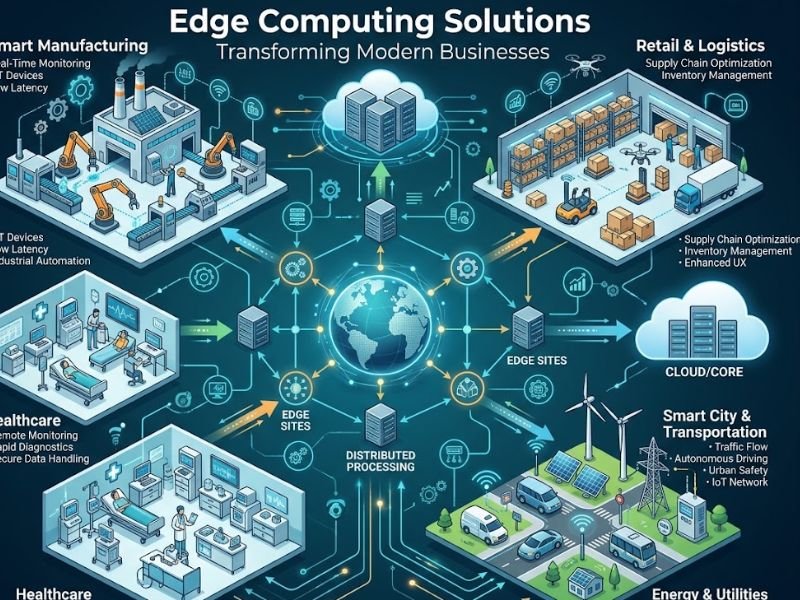
In today’s digital world, businesses generate massive amounts of data from connected devices, applications, sensors, cameras, and cloud platforms. Processing all of this information through centralized data centers can sometimes create delays, increase bandwidth usage, and affect performance. This is where Edge Computing Solutions are becoming increasingly important. By processing data closer to where it is generated, edge computing can help organizations reduce latency, improve real-time decision-making, and build more responsive digital systems. From manufacturing and healthcare to retail, transportation, and smart cities, edge technology is changing how businesses manage and use data.
What Are Edge Computing Solutions?
Edge Computing Solutions are technologies and infrastructure designed to process data closer to its source rather than sending every piece of information to a centralized cloud or data center. The “edge” can include devices, gateways, local servers, routers, industrial computers, and other computing systems located near users or connected devices.
Traditional cloud computing often requires data to travel to a remote data center for processing before the results are returned. Edge computing reduces this distance by performing some processing locally. This approach can be particularly useful for applications where speed, reliability, and real-time responses are important.
How Edge Computing Works
Edge computing works by moving computing resources closer to the devices and systems generating data. Instead of transferring all raw information to a central cloud platform, edge devices can collect, analyze, filter, and process data locally.
For example, a smart factory may use cameras and sensors to monitor production equipment. An edge computer can analyze sensor information immediately and identify unusual machine behavior. Only important information or summarized data may then be sent to a central cloud platform for long-term storage and advanced analysis.
This combination of local processing and cloud connectivity allows organizations to benefit from both fast decision-making and centralized data management.
Key Benefits of Edge Computing Solutions
One of the biggest advantages of Edge Computing Solutions is reduced latency. Because data does not always need to travel to a distant data center, applications can respond more quickly. This is especially important for autonomous vehicles, industrial automation, remote monitoring, gaming, and other systems that require rapid responses.
Another major benefit is reduced bandwidth consumption. Businesses with thousands or millions of connected devices can generate enormous quantities of data. Sending all of that information to the cloud can consume significant network resources. Processing data locally allows organizations to send only relevant information to centralized systems.
Edge computing can also improve reliability. Some edge applications can continue operating even when connectivity to the central cloud is temporarily unavailable. This can be valuable in remote locations, industrial environments, and critical infrastructure where uninterrupted operation is important.
Security and privacy can also benefit from local processing. Certain sensitive information can be analyzed locally instead of being transmitted continuously across networks. However, organizations still need strong security controls because edge devices themselves can become potential targets for cyberattacks.
Edge Computing Solutions in Different Industries
Manufacturing
Manufacturing is one of the major areas where edge computing is being adopted. Smart factories use sensors, cameras, robotics, and industrial machines to generate real-time data. Edge systems can process this information locally to monitor equipment performance, identify potential problems, and support automated production processes.
Predictive maintenance is another important application. By analyzing machine data at the edge, manufacturers can detect unusual patterns before equipment fails, potentially reducing unexpected downtime and maintenance costs.
Healthcare
Healthcare organizations increasingly use connected medical devices and monitoring systems that generate large amounts of data. Edge computing can help process information closer to the patient or medical equipment.
For example, wearable devices and patient-monitoring systems can analyze certain information locally and send important alerts to healthcare professionals. This can support faster responses while reducing unnecessary data transmission.
Retail
Retail businesses can use edge technology for smart stores, inventory management, customer analytics, security cameras, and point-of-sale systems. Local processing can allow retailers to analyze information quickly without relying entirely on a remote cloud service.
Edge computing can also support personalized customer experiences by processing information from connected devices and store systems in near real time.
Transportation and Smart Cities
Connected vehicles, traffic-management systems, surveillance cameras, and public infrastructure can produce enormous amounts of information. Sending all this data to centralized data centers may introduce delays.
Edge Computing Solutions allow transportation systems and smart-city infrastructure to process information closer to where events occur. This can support applications such as traffic monitoring, intelligent transportation systems, parking management, and real-time environmental monitoring.
Edge Computing and Cloud Computing
Edge Computing Solutions
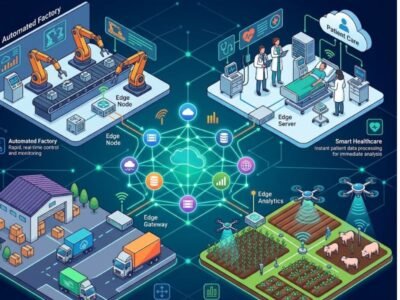
Edge computing does not necessarily replace cloud computing. Instead, the two technologies can work together. Cloud platforms provide centralized storage, large-scale processing, machine learning, analytics, and management, while edge systems provide fast local processing.
This hybrid approach allows businesses to decide which information should be processed locally and which data should be transferred to the cloud. For example, an edge device may analyze sensor data in real time while sending historical information to a cloud platform for long-term analytics.
This relationship between edge and cloud computing creates a flexible architecture that can support both real-time applications and large-scale data processing.
How to Choose the Right Edge Computing Solutions
Businesses should consider several factors before implementing an edge computing strategy. The first is the type and volume of data being generated. Organizations should determine where data is produced, how quickly it needs to be processed, and how much information must be stored.
Security is another important consideration. Edge devices should use strong authentication, encryption, access controls, monitoring, and regular software updates. Organizations should also consider scalability because the number of connected devices may increase over time.
Compatibility is equally important. Edge infrastructure should integrate with existing cloud platforms, business applications, networks, and IoT devices. Choosing flexible technologies can make future expansion easier.
The Future of Edge Computing
The future of edge computing is closely connected to artificial intelligence, the Internet of Things, 5G networks, robotics, and automation. As more devices become connected, organizations will need faster and more efficient ways to process information.
AI at the edge, often called edge AI, can allow devices to perform intelligent analysis locally. For example, cameras can identify objects, industrial systems can detect anomalies, and connected devices can make decisions without constantly communicating with a remote cloud server.
As businesses continue adopting connected technologies, Edge Computing Solutions are expected to become an important part of modern digital infrastructure.
Conclusion
Edge computing is changing the way organizations collect, process, and use data. By bringing computing resources closer to where information is generated, businesses can reduce latency, improve responsiveness, lower bandwidth requirements, and support applications that require real-time processing. From manufacturing and healthcare to retail, transportation, and smart cities, edge technology has applications across many industries.
The combination of edge and cloud computing can provide businesses with a flexible approach to modern data management. As IoT devices, AI applications, and connected systems continue to expand, Edge Computing Solutions can play an increasingly important role in building faster, more reliable, and intelligent digital environments.
FAQs
What are Edge Computing Solutions?
Edge Computing Solutions are technologies that process data closer to the location where it is generated instead of sending all information to a centralized cloud or data center.
What is the main benefit of edge computing?
The main benefits include lower latency, reduced bandwidth usage, faster processing, improved reliability, and better support for real-time applications.
Is edge computing better than cloud computing?
Edge and cloud computing serve different purposes. Edge computing is useful for local and real-time processing, while cloud computing provides centralized storage, analytics, and large-scale computing. Many organizations use both technologies together.
Where is edge computing used?
Edge computing is used in manufacturing, healthcare, retail, transportation, smart cities, telecommunications, security, agriculture, and many IoT applications.
What is the future of edge computing?
The future of edge computing is expected to involve greater integration with artificial intelligence, 5G, IoT, robotics, automation, and real-time analytics.

COMMENTS