
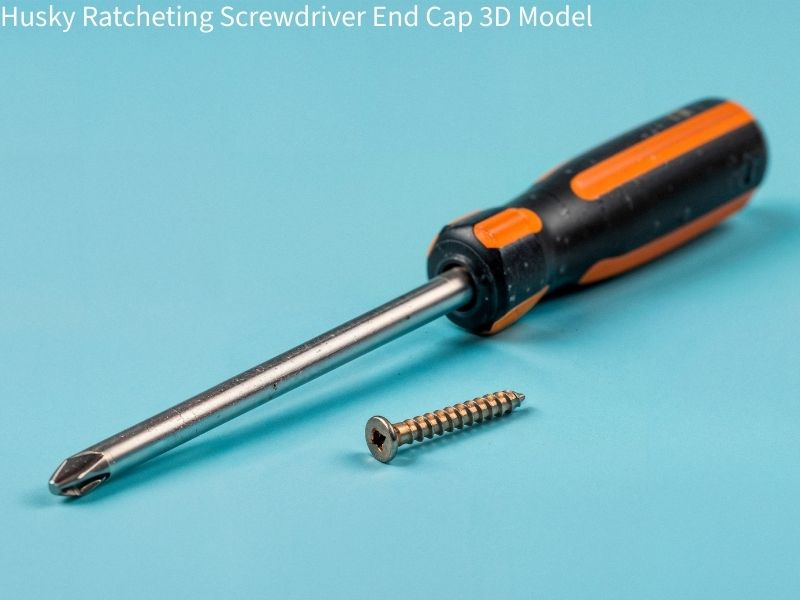
The 3D model of the Husky ratcheting screwdriver end cap is a hot topic for DIYers, makers, and even professionals who prefer tool repairing to replac
The 3D model of the Husky ratcheting screwdriver end cap is a hot topic for DIYers, makers, and even professionals who prefer tool repairing to replacing them. Husky ratcheting screwdrivers are synonymous with long-lasting construction, easy grip, and smooth ratcheting. However, the end cap the most important but frequently neglected part might eventually get your screwdriver unfit for use. It might crack, loosen, or just disappear. Once this occurs, the screwdriver turns into a pain to use and loses a lot of its ergonomic advantage. Luckily, the combination of 3D modeling and 3D printing allows us to replicate this minuscule yet critical component with accuracy and dependability. The present article is a thorough, uncomplicated elucidation of the husky ratcheting screwdriver end cap 3D model, its importance, design process, and its successful printing and usage. The information is presented in a well-structured paragraph form with appropriate headings, making it accessible to both novice and experienced users.
Understanding the Role of the End Cap in a Ratcheting Screwdriver
The end cap of a ratcheting screwdriver is essential for both comfort and performance. It is the rotating part at the back of the handle that enables the user to apply force downward while the handle rotates freely in the palm. This configuration alleviates wrist fatigue and gives better control, particularly when the fastening or loosening is done repetitively. A screwdriver without a good end cap may still screw or unscrew, but the user will definitely feel the difference in usability. In ratcheting screwdrivers made by Husky, the end cap is mostly made to snap or to be press-fitted into the handle while still being able to rotate freely. This combination of secure fixing and effortless movement calls for exacting tolerances. When the original end cap breaks down, it is often very inconvenient to throw out the whole screwdriver, especially when the internal ratcheting mechanism is still working perfectly.
What Is a Husky Ratcheting Screwdriver End Cap 3D Model?
A 3D model of a husky ratcheting screwdriver end cap is the result of a computer-aided design (CAD) process, which produces a digital file of what an end cap would be like in reality. It is a very detailed file that shows the original end cap in exact dimensions, with all its functional features, and so on. Once the model is done, it can be converted into a file suitable for 3D printing and then made with the help of a printer. The main reason for this model to exist is to let people easily produce a new end cap whenever they need one. But apart from that, even the original can be changed to make it more durable, better gripping, or just for good looks. This versatility is no doubt one of the biggest advantages of applying 3D modeling for fixing tools.
Why 3D Modeling Is Ideal for Replacing Tool Parts
3D modeling is especially perfect for tiny replacement parts like screwdriver end caps. These parts are very cheap to manufacture, but the cost of purchasing them separately is usually high. Manufacturers hardly ever sell them as separate items, thus compelling the customers to buy complete toolsets. With a 3D model of a husky ratcheting screwdriver end cap, the users get the upper hand in the repair process. They will be able to produce the part every time it is needed, change the size to make it fit better, and try out stronger materials. This technique not only saves money but also brings about less waste and the lifespan of the tools, which would otherwise have been discarded.
Measuring and Designing the End Cap
The process of creating a precise end cap starts with precise measuring. Precision is very important because even a slight mistake can impact the way the cap fits and its ability to rotate. It is a good idea to use digital calipers to get the measurements of the original cap, such as the outer diameter, inner diameter, depth, and any internal retention features, accurately. Taking measurements several times is a good practice to guarantee precision. After that, CAD software is employed to replicate the measurements. The parametric modeling tools turn out to be very handy as they provide the opportunity to make changes easily at a later stage. The design generally initiates from a basic circular shape, after which it is hollowed out and the snap-fit features or internal lips are incorporated. Sometimes, rounded edges and smooth transitions are also given to the design to make it more comfortable for the user.
Customization Benefits of a 3D Model
One big benefit of a husky ratcheting screwdriver end cap 3d model is personalization. The users are able to alter the 3d cap not only according to their needs but also according to the original factory design. The wall thickness can be made thicker in order to give the cap extra strength, the grip pattern can be even changed to provide better control and the surface textures can be modified for comfort. Some people even imprint their initials or signs on the cap to make their tools unique. Personalization also makes room for functional enhancement. For instance, if the areas prone to stress are reinforced, then the chance of cracking will be minimized and if the tolerances are adjusted a bit, then rotation would be smoother than in the case of the original part.
Choosing the Right Material for 3D Printing
Choosing the right material is one of the major factors determining the performance and longevity of the product. PLA is the least demanding material in terms of printing and availability, but it does not suit the application where its exposure to continuous friction and hand pressure is present. PETG is usually a better solution as it gives tougher, more flexible, and more wear-resistant parts, all the while being relatively easy to print. For professional users, ABS or nylon can provide exceptionally strong and heat-resistant parts. On the other hand, these materials can only be processed under very controlled conditions and by very experienced personnel. Most simply put, PETG is still the most preferred material by home users as it offers the best balance between end-cap durability and printability.
Printing, Fitting, and Testing the End Cap
To achieve good results, proper print settings will be a must. Using a moderate layer height, enough wall thickness, anda higher infill percentage will lead to a stronger part. The best printing orientation should be one that directs the stress along the layer lines that are least affected, particularly around the snap-fit areas. A test fit for the end cap should be done slowly after printing. The cap should fit tightly but at the same time be able to rotate freely. Light sanding can be applied to the fit for adjustment, and if the cap is too tight or too loose,e then some design changes can also be made. Durability and comfort will be tested by regular use and will be confirmed in this way.
Conclusion
The 3D model of the Husky ratcheting screwdriver end cap is a realistic demonstration of the benefits that modern technology can offer in solving daily problems. Users can make and print a perfect replacement for the broken part, which will restore the usability and comfort instead of discarding a fully working screwdriver just because of a minor issue. By Precision measurement, clever design, right material selection, and thorough testing, a 3D printed end cap can perform as well as or even better than the original. This method not only saves money but also lessens the amount of waste produced and gives users the power to repair and even improve their own tools.
Frequently Asked Questions (FAQs)
What is a husky ratcheting screwdriver end cap 3d model used for?
It is used to create a replacement end cap for a Husky ratcheting screwdriver using a 3D printer, restoring comfort and functionality.
Is a 3D-printed end cap durable enough for daily use?
Yes, when printed with suitable materials like PETG or nylon and proper settings, it can withstand regular use.
Do I need advanced CAD skills to design an end cap?
Basic CAD knowledge is usually sufficient. Many designs are simple and can be created or modified by beginners.
Which material is best for printing an end cap?
PETG is commonly recommended due to its balance of strength, flexibility, and ease of printing.
Can I customize the end cap design?
Yes, customization is one of the biggest benefits. You can adjust dimensions, add grip textures, or personalize the appearance.
Will a 3D-printed end cap fit all Husky screwdrivers?
Not necessarily. Measurements vary by model, so the design should match the specific screwdriver version.

COMMENTS