
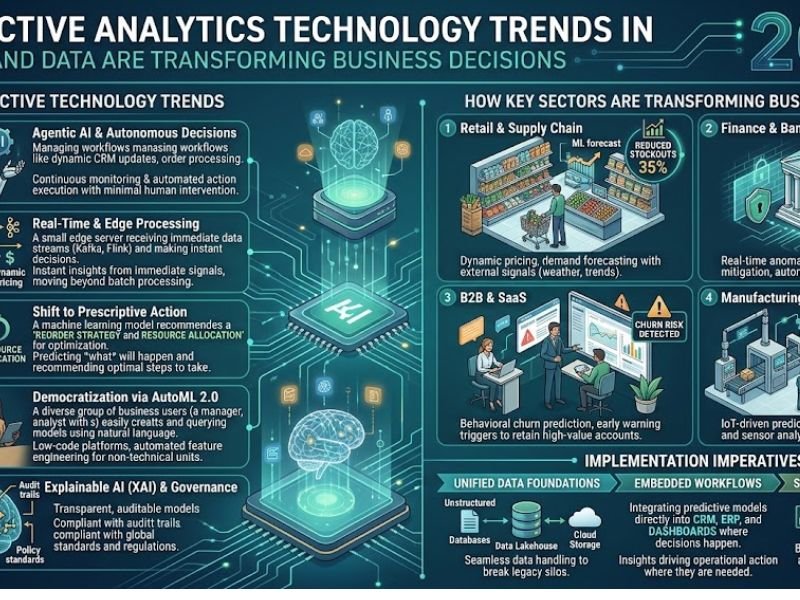
Introduction Predictive analytics technology trends are rapidly changing how businesses use data to make smarter and faster decisions. Instead of rel
Introduction
Predictive analytics technology trends are rapidly changing how businesses use data to make smarter and faster decisions. Instead of relying only on historical reports, modern organizations can use artificial intelligence, machine learning, and advanced data models to identify possible future outcomes. From forecasting customer behavior to predicting market demand and operational risks, predictive technology is becoming an important part of digital transformation. Predictive data analytics, AI-powered analytics, and business intelligence technology are helping organizations turn large amounts of information into valuable insights. In 2026, businesses across industries are increasingly using predictive systems to improve planning, reduce uncertainty, and gain a competitive advantage.
What Is Predictive Analytics?
Predictive analytics is the process of using historical data, statistical models, artificial intelligence, and machine learning to identify patterns and estimate future outcomes.
For example, a business can analyze previous customer purchases to predict which products may become popular in the future. A financial organization can use data to identify potential risks. Healthcare providers can analyze information to improve planning and resource management.
The goal is not to predict the future with complete certainty. Instead, predictive analytics provides data-based probabilities and insights that support better decision-making.
As technology improves, predictive models are becoming faster, more accurate, and easier for businesses to use.
Predictive Analytics Technology Trends and AI Integration
One of the most important predictive analytics technology trends is the deeper integration of artificial intelligence.
Traditional analytics systems often required significant manual analysis. AI can automate many parts of the process, including pattern recognition and data processing.
AI systems can analyze large and complex datasets much faster than traditional methods.
Machine learning models can also improve over time by learning from new data.
This combination is making predictive technology more useful for businesses that need real-time or near-real-time insights.
The growing use of AI-powered analytics is allowing organizations to move beyond simple reports and explore more advanced forecasting capabilities.
The Rise of AI-Powered Analytics
AI-powered analytics is becoming a major part of modern business technology.
Artificial intelligence can help identify hidden relationships within data that may be difficult for humans to detect manually.
For example, an AI system might identify connections between customer behavior, seasonal trends, pricing, and market demand.
Businesses can then use these insights to make better strategic decisions.
AI-powered analytics can support:
- Sales forecasting
- Customer behavior analysis
- Fraud detection
- Inventory planning
- Risk management
- Marketing optimization
- Supply chain forecasting
As AI tools become more accessible, predictive capabilities are no longer limited to large technology companies.
Small and medium-sized businesses are also gaining access to advanced analytics platforms.
Predictive Data Analytics for Better Business Decisions
Predictive data analytics helps organizations move from reactive decision-making to proactive planning.
Instead of waiting for a problem to happen, businesses can identify possible risks earlier.
For example, a company may analyze operational data to predict equipment maintenance needs before a major failure occurs.
Retailers can forecast demand to improve inventory management.
Marketing teams can predict which customer groups are most likely to respond to specific campaigns.
These applications can help companies save time, reduce costs, and improve customer experiences.
The value of predictive analytics comes from turning raw information into actionable insights.
Real-Time Predictive Analytics
Another important development is the growth of real-time analytics.
Businesses today generate massive amounts of data through websites, applications, connected devices, transactions, and digital platforms.
Traditional reporting systems may analyze this information after a significant delay.
Real-time predictive systems can process data more quickly.
This allows organizations to respond faster to changing conditions.
For example, an e-commerce platform may analyze visitor behavior while customers are actively browsing.
A cybersecurity system may identify unusual activity and respond to potential threats immediately.
Real-time capabilities are becoming an important part of modern business intelligence technology.
Predictive Analytics Technology Trends in Customer Experience
Customer experience is another area where predictive analytics technology trends are having a major impact.
Businesses want to understand customer needs before those needs are directly expressed.
Predictive models can analyze browsing behavior, purchase history, preferences, and interactions.
This information can help businesses create more personalized experiences.
For example, companies can recommend relevant products or provide targeted offers.
Customer service teams may also use predictive tools to identify customers who are likely to need support.
However, businesses must balance personalization with privacy.
Responsible data management and transparency are essential when using customer information.
Automation and Predictive Intelligence
Automation is becoming more intelligent through predictive technology.
Traditional automation follows predefined rules.
Predictive systems can add another layer by analyzing data and identifying likely future situations.
For example, a system might automatically adjust inventory levels based on predicted demand.
A financial platform may flag transactions that appear unusual based on previous patterns.
This combination of automation and prediction can improve operational efficiency.
Businesses can reduce repetitive tasks while using data to make smarter decisions.
Business Intelligence Technology Is Becoming More Predictive
Traditional business intelligence technology focused mainly on dashboards, reports, and historical performance.
Modern business intelligence platforms are evolving.
They increasingly include forecasting, artificial intelligence, machine learning, and predictive capabilities.
This allows business leaders to ask not only:
“What happened?”
But also:
“What is likely to happen next?”
This shift is changing how organizations use data.
Decision-makers can explore possible future scenarios instead of relying entirely on past performance.
Predictive business intelligence can support strategic planning and long-term growth.
Predictive Analytics in Healthcare and Finance
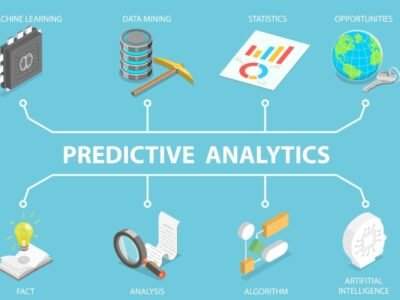
Predictive Analytics Technology Trends
Many industries are adopting predictive technology for specialized purposes.
In healthcare, analytics can help organizations improve planning, resource allocation, and operational efficiency.
In finance, predictive models can support risk assessment, fraud detection, and market analysis.
These industries require careful data governance because the information involved can be highly sensitive.
Accuracy, security, and responsible use are essential.
As predictive systems become more advanced, organizations will need strong policies to ensure technology is used appropriately.
The Growing Importance of Data Quality
Predictive systems depend heavily on the quality of available data.
Poor or incomplete information can lead to unreliable predictions.
This is why data management is becoming increasingly important.
Businesses need to collect accurate, relevant, and well-organized information.
Before implementing advanced predictive systems, organizations should consider:
- Data accuracy
- Data security
- Data integration
- Data governance
- Privacy requirements
- Regular data updates
Artificial intelligence can improve analysis, but it cannot completely solve problems caused by poor-quality data.
Challenges in Predictive Analytics
Despite its benefits, predictive analytics also presents challenges.
One major issue is complexity.
Advanced models can be difficult to understand and manage without experienced professionals.
Another challenge is privacy.
Businesses must handle customer and organizational data responsibly.
Bias can also affect predictive models.
If the data used to train a system contains unfair patterns, the predictions may reproduce those problems.
Organizations should regularly review models and ensure they are being used responsibly.
Technology should support human decision-making rather than replace critical human judgment completely.
The Future of Predictive Analytics Technology
The future of predictive analytics will likely involve stronger integration between AI, automation, cloud computing, and real-time data.
Future systems may become easier for non-technical users to operate.
Business leaders may be able to ask questions using natural language and receive predictive insights without requiring complex technical processes.
The continued development of AI-powered analytics will also make forecasting more accessible.
Organizations may increasingly use predictive models across marketing, operations, finance, cybersecurity, and customer experience.
The businesses that combine strong data practices with responsible AI adoption may gain the greatest benefits.
Why Businesses Should Follow Predictive Analytics Technology Trends
Companies that understand predictive analytics technology trends can prepare more effectively for future changes.
Predictive technology helps organizations identify opportunities and risks before they become obvious.
It can support better planning, smarter resource allocation, and more personalized customer experiences.
Businesses do not need to implement every new analytics tool immediately.
Instead, they should identify the areas where predictive insights can provide real value.
A focused strategy is often more effective than adopting technology simply because it is new.
Conclusion
Predictive analytics technology trends are reshaping how organizations understand data and make decisions. Through predictive data analytics, businesses can identify patterns and estimate possible future outcomes. The growth of AI-powered analytics is making these capabilities faster and more accessible, while modern business intelligence technology is moving beyond historical reporting toward forecasting and predictive insights. In 2026 and beyond, predictive analytics will likely become an increasingly important part of business strategy. Companies that invest in quality data, responsible AI practices, and practical predictive solutions will be better prepared to respond to changing markets and emerging opportunities.
FAQs
What are predictive analytics technology trends?
Predictive analytics technology trends refer to new developments in artificial intelligence, machine learning, automation, real-time data analysis, and forecasting technologies.
What is predictive data analytics?
Predictive data analytics uses historical and current data to identify patterns and estimate possible future outcomes.
How does AI-powered analytics help businesses?
AI-powered analytics can process large amounts of data, identify patterns, automate analysis, and support faster decision-making.
What is predictive business intelligence?
Predictive business intelligence combines traditional reporting and dashboards with forecasting, AI, and machine learning capabilities.
Which industries use predictive analytics?
Predictive analytics is used across industries including retail, finance, healthcare, manufacturing, marketing, cybersecurity, and logistics.
Is predictive analytics always accurate?
No. Predictive analytics provides estimates and probabilities based on available data. Accuracy depends on data quality, model design, and changing real-world conditions.

COMMENTS