
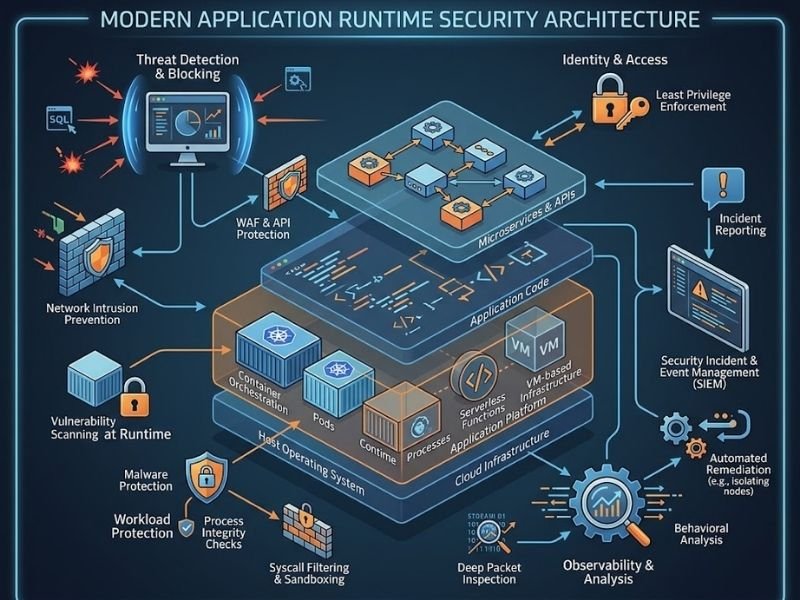
Introduction Runtime Security has become an important part of protecting modern applications as businesses increasingly depend on cloud platforms, AP
Introduction
Runtime Security has become an important part of protecting modern applications as businesses increasingly depend on cloud platforms, APIs, containers, and continuously changing software environments. Traditional security approaches often focus on finding vulnerabilities before an application is deployed, but threats can also appear while an application is running. This is where runtime threat detection becomes valuable. By monitoring application behavior and identifying suspicious activity during execution, organizations can respond to potential risks more quickly. Alongside application security and modern cloud security solutions, Runtime Security provides an additional layer of protection for businesses operating complex digital environments.
What Is Runtime Security?
Runtime Security is the practice of monitoring and protecting applications, workloads, and systems while they are actively running. Instead of focusing only on vulnerabilities discovered during development, runtime protection looks at what an application is actually doing during operation. Security teams can monitor processes, network activity, system behavior, access attempts, and other signals to identify potentially suspicious actions.
For modern applications that change frequently, this real-time perspective can be particularly useful. Runtime protection does not replace secure coding, vulnerability management, or traditional security controls. Instead, it works alongside them to create a broader security strategy.
Why Runtime Security Matters for Modern Applications
Modern applications are often distributed across cloud environments, containers, APIs, microservices, and third-party services. This complexity can make it difficult to predict every possible security scenario before deployment. Even when developers follow secure development practices, new threats can emerge after an application is deployed. Runtime Security helps address this challenge by observing application behavior in its live environment.
If unusual activity occurs, security systems may generate alerts or take predefined actions depending on their configuration. This approach can help organizations reduce the time between detecting suspicious behavior and responding to it.
Runtime Security and Application Security
Application security covers the processes and technologies used to protect software throughout its development and operational lifecycle. It can include secure coding, vulnerability scanning, penetration testing, identity controls, access management, and security testing. Runtime protection adds another layer by focusing on application behavior while the software is running.
For example, an application may pass security tests before deployment but later encounter a new attack technique. Runtime monitoring can potentially identify unusual behavior that traditional pre-deployment testing may not detect. A strong security program therefore combines preventive controls with monitoring and response capabilities.
The Role of Runtime Threat Detection
Runtime threat detection focuses on identifying suspicious or potentially malicious behavior while a system is operating. Instead of asking only whether software contains a known vulnerability, runtime monitoring can ask whether something unusual is happening right now. Examples could include unexpected processes, abnormal network connections, unusual privilege activity, or suspicious access attempts.
The system can use predefined rules, behavioral analysis, or other detection techniques to identify activity that deserves investigation. The quality of detection depends heavily on the technology being used and how it is configured. Too many alerts can overwhelm security teams, while overly restrictive detection rules may miss important activity.
Runtime Security in Cloud Environments
Cloud computing has changed how organizations build and operate applications. Businesses can quickly create workloads, scale resources, and deploy applications across different environments. However, cloud infrastructure can also introduce new security challenges. Modern cloud security solutions can provide controls for identity, networks, workloads, data, and applications.
Runtime protection can complement these controls by focusing on what workloads are doing during operation. For organizations using containers, serverless environments, or cloud-native applications, runtime monitoring can provide additional visibility into active workloads.
Containers and Runtime Security
Containers allow developers to package applications and their dependencies into portable environments. They are widely used in modern software development because they can make deployment and scaling easier. However, containerized environments can introduce security concerns if workloads behave unexpectedly or become compromised.
Runtime Security can monitor container activity and identify behavior that does not match expected patterns. Security teams may use this information to investigate suspicious processes, unexpected connections, or unusual changes inside a container. Container security should still begin earlier in the development lifecycle. Image scanning, access controls, secure configurations, and vulnerability management remain important.
Runtime Security for APIs and Microservices
APIs and microservices allow different application components to communicate with each other. They provide flexibility, but they also increase the number of connections that security teams need to monitor. A compromised service could potentially be used to access other parts of an application environment.
Runtime monitoring can help identify unusual communication patterns or unexpected behavior. Combined with strong authentication, authorization, encryption, and API security practices, runtime controls can provide an additional defensive layer.
How AI Can Support Runtime Security
Runtime Security
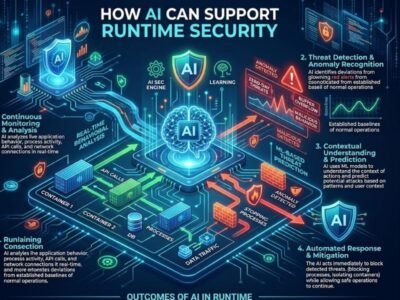
Artificial intelligence and machine learning are increasingly being explored for cybersecurity applications. AI-based systems can analyze large volumes of activity and potentially identify patterns that are difficult to detect manually. For example, an AI-assisted security system might compare current behavior with established patterns and highlight significant deviations.
However, AI should not be treated as a perfect security solution. Models can produce false positives or miss sophisticated attacks. Human security professionals still need to investigate important alerts and make decisions about response. AI is most useful when it improves visibility and helps security teams prioritize their workload.
Benefits of Runtime Security
There are several potential benefits to implementing runtime protection.
Real-time visibility: Security teams can observe applications and workloads while they are operating.
Threat detection: Suspicious behavior can potentially be identified during an active attack.
Faster response: Alerts can help security teams investigate unusual activity more quickly.
Cloud workload protection: Runtime monitoring can complement broader cloud security solutions.
Additional application protection: It adds another defensive layer alongside traditional application security controls.
These benefits depend on proper implementation, monitoring, and integration with the organization’s wider security strategy.
Runtime Security Challenges
Although Runtime Security offers valuable capabilities, it also comes with challenges. Large environments can generate huge amounts of security data. Without proper configuration, teams may receive too many alerts. Performance is another consideration. Security monitoring should protect applications without creating unnecessary overhead.
Organizations must also determine which workloads require deeper monitoring and how long security information should be retained. Integration can be challenging when applications operate across multiple cloud providers, container platforms, and legacy systems. Security teams therefore need a clear strategy rather than simply deploying another monitoring tool.
Best Practices for Runtime Security
Organizations can improve their approach by combining runtime monitoring with secure development practices. Start by identifying critical applications and workloads. Define normal application behavior so unusual activity can be identified more effectively. Use strong identity and access controls and follow the principle of least privilege.
Keep applications, containers, operating systems, and dependencies updated. Integrate runtime alerts with existing security operations processes so important events can be investigated quickly. Regularly review detection rules and remove unnecessary alerts. Most importantly, Runtime Security should be part of a broader security program rather than treated as a standalone solution.
Choosing the Right Cloud Security Solutions
Organizations have different infrastructure, applications, and security requirements. When evaluating cloud security solutions, businesses should consider visibility, workload coverage, integration, scalability, alert quality, reporting, and ease of management. Compatibility is particularly important for companies using multiple cloud platforms or container environments.
Security teams should also consider whether the solution supports their existing monitoring and incident-response processes. A product that generates large amounts of information without helping teams prioritize threats may create more work rather than improving security.
Future of Runtime Security
The future of Runtime Security is likely to involve greater automation, improved behavioral analysis, and stronger integration with cloud-native development. As applications become more distributed, security teams will need better visibility into what workloads are doing. Automation could help organizations respond to certain low-risk events without requiring manual intervention.
AI may also help security teams analyze large volumes of activity and prioritize potentially serious threats. At the same time, organizations will need to maintain human oversight, especially when automated actions could affect important business systems.
Conclusion
Runtime Security provides an important layer of protection for modern applications by focusing on what software and workloads are doing while they are actively running. It complements application security, vulnerability management, identity controls, and cloud security solutions rather than replacing them. With effective runtime threat detection, organizations can gain greater visibility into suspicious behavior and potentially respond to threats more quickly. As cloud-native applications, containers, APIs, and distributed systems continue to grow, runtime protection is likely to become an increasingly important part of a comprehensive cybersecurity strategy.
FAQs
What is Runtime Security?
Runtime Security protects applications and workloads while they are actively running by monitoring behavior and identifying potentially suspicious activity.
How is Runtime Security different from application security?
Application security covers a broader range of practices throughout the software lifecycle. Runtime protection specifically focuses on detecting and responding to threats during application execution.
Why is runtime threat detection important?
Runtime threat detection can help identify unusual behavior that may occur after an application has been deployed, providing security teams with additional visibility during active operation.
Does Runtime Security replace vulnerability scanning?
No. Vulnerability scanning, secure coding, penetration testing, and patch management remain important. Runtime protection provides an additional security layer.
Is Runtime Security useful for cloud applications?
Yes. Runtime monitoring can complement cloud security solutions by providing visibility into the behavior of active cloud workloads, containers, and applications.
Can AI improve Runtime Security?
AI can potentially help analyze large volumes of security data, identify behavioral patterns, and prioritize alerts, but human review remains important for investigating significant security events.

COMMENTS