
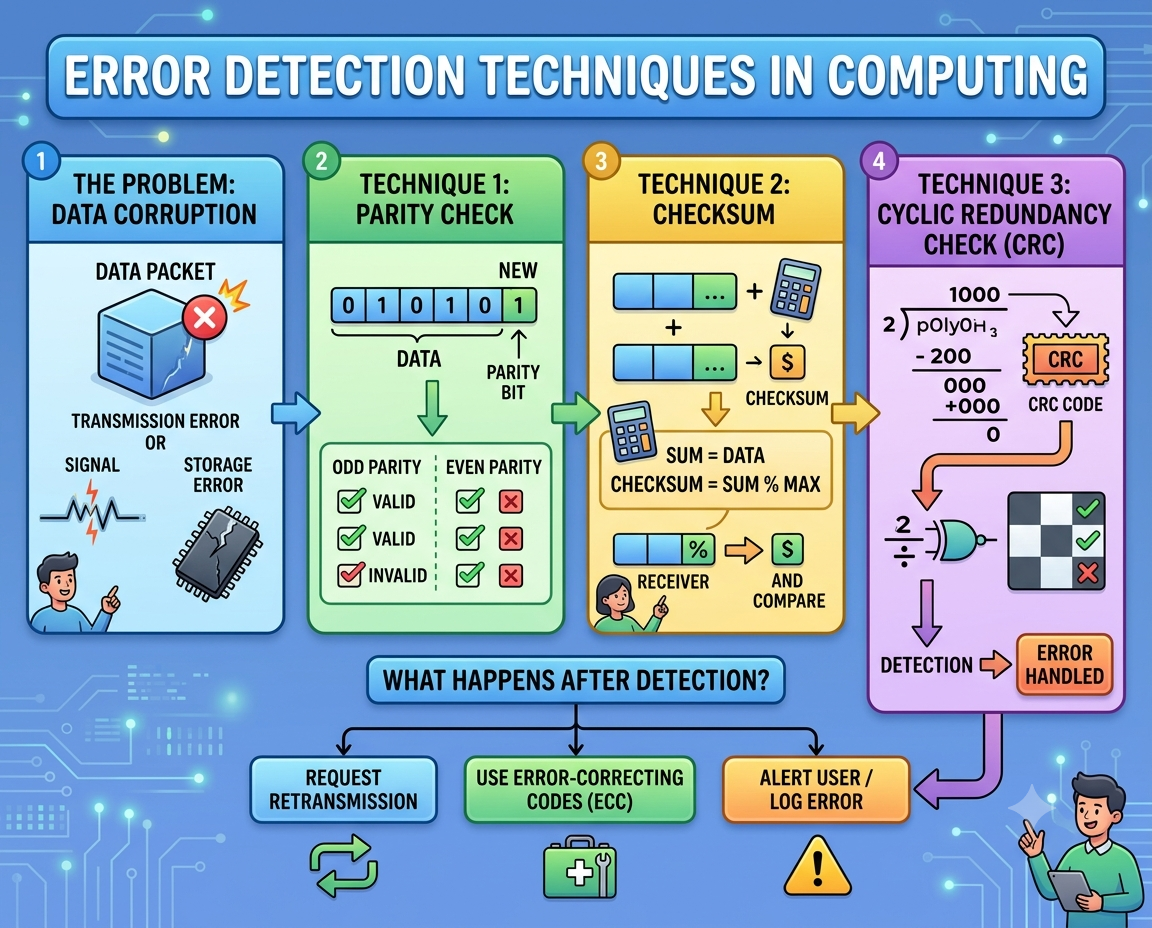
Introduction In today's digital world, data is constantly being transmitted between computers, servers, mobile devices, and networks. Whether you're
Introduction
In today’s digital world, data is constantly being transmitted between computers, servers, mobile devices, and networks. Whether you’re sending an email, streaming a video, or downloading a file, information travels through various communication channels where errors can occur. These errors may result from electrical interference, hardware failures, software issues, or network disruptions. To ensure information remains accurate and reliable, computers use Error Detection Techniques in Computing. These techniques help identify problems in transmitted or stored data before they cause serious issues. Understanding how error detection works is essential for anyone interested in computer science, networking, or information technology.
What Are Error Detection Techniques in Computing?
Error Detection Techniques in Computing are methods used to identify whether data has been altered, corrupted, or damaged during storage or transmission. The goal is to verify that information received by a system matches the information originally sent.
Errors can occur for many reasons, including signal interference, faulty hardware, network congestion, and software malfunctions. Without proper detection mechanisms, corrupted data could lead to inaccurate results, system failures, or security risks.
Error detection systems act as quality control mechanisms that verify information before it is processed. If an error is detected, the system may request retransmission or initiate corrective actions to maintain accuracy.
Why Data Integrity Is Important
One of the primary reasons for implementing Error Detection Techniques in Computing is to maintain data integrity. Data integrity refers to the accuracy, consistency, and reliability of information throughout its lifecycle.
Businesses, financial institutions, healthcare providers, and government agencies depend on accurate data to make critical decisions. Even a small error in transmitted information can lead to significant operational problems.
For example, incorrect banking transactions, corrupted medical records, or damaged software files can have serious consequences. Error detection techniques help ensure that information remains trustworthy and unchanged from its original form.
Maintaining strong data integrity is essential for reliable communication, secure transactions, and effective business operations.
Common Error Detection Methods
Several error detection methods are used in modern computing systems. Each technique offers different levels of protection depending on the application and system requirements.
Parity Check
Parity checking is one of the simplest error detection techniques. An additional bit, known as a parity bit, is added to data before transmission. The parity bit helps determine whether the total number of ones in the data is even or odd.
When the receiver checks the parity, it can identify whether a transmission error has occurred. Although parity checks are simple and efficient, they are limited because they may not detect all types of errors.
Checksum Verification
A checksum is a calculated value generated from a block of data. Before transmission, the sender calculates the checksum and sends it along with the data.
The receiver performs the same calculation after receiving the information. If the calculated checksum differs from the transmitted checksum, an error is detected.
Checksum verification is commonly used in file transfers, software downloads, and network communications because it provides a simple way to validate data accuracy.
Understanding Cyclic Redundancy Check (CRC)
One of the most widely used error detection methods is the Cyclic Redundancy Check (CRC). CRC provides a highly effective way to detect errors in digital communications and storage systems.
The Cyclic Redundancy Check (CRC) works by performing mathematical calculations on data before transmission. The result of this calculation, known as the CRC value, is attached to the transmitted data.
When the data arrives at its destination, the receiving system performs the same calculation. If the calculated CRC matches the transmitted CRC, the data is assumed to be accurate. If the values differ, an error has occurred.
Because of its effectiveness and reliability, CRC is widely used in networking protocols, hard drives, USB devices, wireless communications, and many other digital systems.
Applications of Error Detection Techniques
Error Detection Techniques in Computing
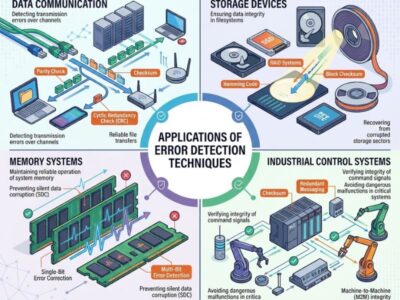
Error Detection Techniques in Computing play an important role in numerous technologies and industries. Almost every digital communication system relies on some form of error detection to ensure accuracy.
Common applications include:
- Computer networks
- Internet communications
- Cloud computing systems
- Wireless networks
- Banking transactions
- Data storage devices
- Software downloads
- Satellite communications
In these environments, even minor errors can disrupt operations or compromise reliability. Error detection mechanisms help maintain system performance and prevent data corruption.
Benefits of Error Detection Techniques
Implementing effective Error Detection Techniques in Computing provides several important benefits. First, they improve reliability by ensuring that transmitted information remains accurate and complete.
Second, they support data integrity, allowing organizations to trust the information they receive and process. This is especially important in industries where accuracy is critical.
Third, error detection improves overall system performance by identifying issues before they cause significant disruptions. Detecting problems early often reduces troubleshooting costs and minimizes downtime.
Finally, these techniques contribute to better user experiences by ensuring that files, messages, and applications function correctly without corruption or data loss.
Error Detection vs Error Correction
While error detection focuses on identifying problems, error correction goes a step further by repairing detected errors automatically.
Error detection techniques indicate whether an issue exists, while error correction systems attempt to reconstruct the original data. Many modern communication systems combine both approaches to maximize reliability.
For example, a network protocol may use Cyclic Redundancy Check (CRC) to detect transmission errors and then request retransmission if corruption is identified.
Together, these technologies help create highly dependable communication systems capable of handling complex data transfers.
The Future of Error Detection in Computing
As digital technologies continue advancing, the importance of Error Detection Techniques in Computing will only increase. Emerging technologies such as artificial intelligence, cloud computing, edge computing, and the Internet of Things generate enormous amounts of data that must be transmitted accurately.
Future systems will likely incorporate more sophisticated detection and correction mechanisms capable of handling increasingly complex communication environments.
Advancements in networking, storage technologies, and cybersecurity will continue driving innovation in error detection methods, ensuring greater reliability and security across digital infrastructures.
Conclusion
Error Detection Techniques in Computing are essential for maintaining reliable communication and protecting valuable information. Through methods such as parity checks, checksum verification, and Cyclic Redundancy Check (CRC), computer systems can identify data corruption and maintain high levels of data integrity.
Understanding these error detection methods helps beginners appreciate how modern computing systems ensure accuracy and reliability. As technology continues evolving, error detection will remain a fundamental component of digital communication, data storage, and information security.
FAQs
1. What are Error Detection Techniques in Computing?
They are methods used to identify errors in data during transmission or storage.
2. Why is data integrity important?
Data integrity ensures information remains accurate, consistent, and reliable throughout its lifecycle.
3. What is a Cyclic Redundancy Check (CRC)?
CRC is an advanced error detection method that uses mathematical calculations to identify data corruption.
4. What is the difference between error detection and error correction?
Error detection identifies problems, while error correction attempts to repair detected errors automatically.
5. Where are error detection methods used?
They are used in computer networks, data storage systems, internet communications, banking systems, and many other digital technologies.

COMMENTS